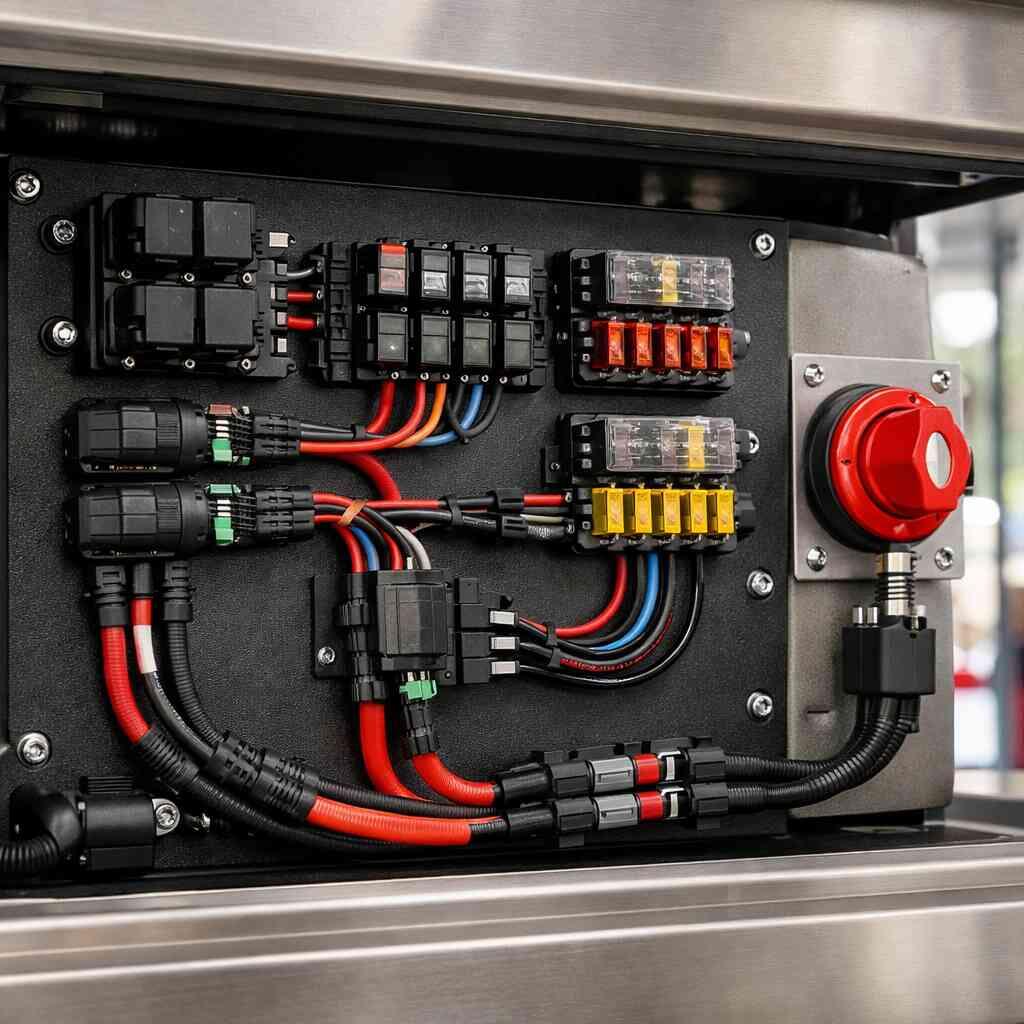
How to Spec Fire Truck Cabling for Labor Day 2026
August 20, 2026
Why Labor Day readiness exposes weak fire truck cabling before the first call
The first hot call after a busy summer has a way of exposing everything you hoped would hold. A truck can look perfect in the bay and still fail under washdown spray, vibration, and heat soak. If you are feeling uneasy about that, you are not overreacting. That unease is usually your best warning. Fire truck cabling rarely fails all at once. It usually starts with a loose connector, a brittle loom, or a wire that has been rubbing for months.
The hidden failure points that show up after a busy summer of heat, vibration, and washdowns
The problems usually hide in plain sight. Heat cooks insulation. Vibration loosens terminations. Washdowns push moisture into connectors that looked sealed yesterday. On the projects we’ve finished this year, those are the failures that appear first during preventative maintenance for apparatus wiring. You may see a scene light flicker, a relay chatter, or a radio drop out for a moment. That tiny symptom often points to a deeper issue in the emergency vehicle electrical systems.
One client brought in a rig after a hose-down revealed a dash warning that came and went. The truck still started. The lights still worked. But the inspection found a corroded terminal buried behind a panel, and the repair took longer because access had been sacrificed for a cleaner look. That is the part most crews miss. Clean routing is useful, but only if it stays serviceable. The best cable protection loom still needs enough access to inspect, tighten, and replace parts without tearing the truck apart.
Why emergency vehicle electrical systems need a seasonal reset before holiday staffing and call volume shift
Holiday staffing changes create a different kind of stress. You may have newer personnel, longer shifts, and a higher chance that someone notices a problem only after it becomes urgent. A seasonal reset gives you time to review fire truck electrical load before the truck is already committed. It also gives you a chance to check chassis wiring integration while the apparatus is still in the shop. That matters because a system that limps through the bay may still fail when the operator turns on multiple loads at once.
Here is what we see most often in August across Florida. The truck gets run hard all summer. Then everyone assumes the same cabling will be fine for the next push. That assumption is expensive. In DeLand, humidity and routine washdowns make connector condition matter even more. If you are comparing approaches, it helps to review fire truck cabling for Labor Day readiness before the schedule tightens.
The difference between a system that looks fine in the bay and one that survives field use
A bay inspection is a snapshot. Field use is a test. The difference usually comes down to three things: load, heat, and movement. In the bay, a circuit may appear stable because it is not fully loaded. On the fireground, lighting circuit cabling, pump panel wiring, and scene light wiring may all energize together. That changes everything. The truck needs cabling that can tolerate real current, real vibration, and real service conditions.
A more reliable system is designed for the next fault, not the current appearance. That means you think about access, labeling, and replacement before you think about aesthetics. It also means you pick components that hold up after repeated wet service. If you want a broader planning lens, emergency vehicle electrical systems in holiday fleet planning is a useful place to start. The goal is not perfection. The goal is a truck that still behaves when the bay doors are open and the scene is loud.
What every apparatus builder gets wrong about fire truck electrical load
A lot of cabling mistakes begin with optimism. Builders assume the load chart is complete, but the truck always grows after delivery. Radios get added. Auxiliary lighting expands. Chargers multiply. Then the original layout starts carrying more than it was meant to handle. That is where power distribution for fire apparatus becomes more than an engineering phrase. It becomes the difference between dependable output and avoidable troubleshooting.
Mapping real power demand across lighting circuit cabling, pump panel wiring, and scene light wiring
You cannot spec cabling correctly until you map every load that can operate together. That means more than counting fixtures. It means understanding how lighting circuit cabling, pump panel wiring, and scene light wiring interact during a response. If the operator can switch several loads on at once, the cabling must support that combined demand without complaint. Many builders size for one circuit at a time, which is too optimistic for real use.
A better method is to build a load map by operating mode: idle, scene, pump, road, and rehab. Each mode creates a different electrical picture. The vehicle electrical layout should reflect that reality, not just a schematic on paper. If you have ever watched a truck behave perfectly until the pump panel and scene lights came on together, you already know why this matters. That is also where a careful review of emergency response vehicle cabling pays off early.
How battery management system planning changes when auxiliary power circuits keep multiplying
As auxiliary loads grow, the battery management system has to do more than keep the engine starting. It has to protect reserve capacity while still supporting the truck’s mission. That gets tricky when auxiliary power circuits keep multiplying over time. Every charger, inverter, and communications add-on changes the demand profile. If the system is not planned with that growth in mind, the cabling and protection devices start working too close to their limits.
We hear this from crews almost every week. They did not add one huge load. They added six small ones. Then the truck starts showing nuisance behavior. A relay warms up. A connector discolors. A fuse trips once, then twice. That is why good wiring harness design must account for future additions, not just present accessories. For crews trying to avoid that trap, fire apparatus wiring and voltage stability is the right concept to keep in view.
Where voltage drop calculation becomes the difference between reliable output and nuisance faults
Voltage drop calculation is not academic. It is the practical answer to why a light is dim, a fan slows, or a radio resets under load. If the run is long, current is high, or the connection quality is uneven, voltage loss grows quickly. That is where the math matters. A system can be “working” and still be underperforming enough to cause nuisance faults.
The hardest part is that voltage drop problems often hide behind good intentions. A circuit is protected. The breaker is correct. The wire even looks substantial. But the distance and load combination make the output unreliable. That is why wire gauge selection should always be tied to the actual circuit path, not a rough guess. If you are comparing cabling approaches for expansion or retrofits, rugged fire truck cabling for summer fleet retrofits offers a useful frame for the decision.
The cabling spec that actually holds up in the real world
The best cabling specification is not the heaviest one. It is the one that fits the load, the environment, and the maintenance plan. That sounds simple, but it is where many builds drift off course. The cabling has to survive heat, moisture, cleaning chemicals, and repeated flexing. It also has to be practical to repair. If a technician cannot reach it, test it, or replace it cleanly, the spec is incomplete.
Choosing wire gauge selection based on current draw, distance, and serviceability instead of guesswork
Start with current draw. Then add distance. Then factor in serviceability. That order matters. Wire gauge selection based only on amperage ignores the reality of the vehicle electrical layout. If the run is long, the wire may need to be larger than intuition suggests. If the route is hard to reach, you may also want a size and termination strategy that is easier to inspect later.
In the field, we see crews regret two opposite mistakes. The first is undersizing, which creates heat and drop. The second is oversizing without planning for termination space, which makes repairs messy and routing tight. Good cabling specification sits between those extremes. It respects the electrical requirement and the hands that will service the truck. For component planning, fire truck connector specifications for harsh-duty electrical layouts is a strong reference point.
Matching cable insulation rating to heat, moisture, and abrasion resistant cable demands
Insulation choice matters because the truck lives in a harsh enclosure. Cable insulation rating should reflect heat exposure, moisture exposure, and abrasion-resistant cable needs. A loom that looks fine on day one can degrade quickly if it rubs against a bracket or sits too close to a heat source. That is especially true in apparatus compartments where movement and temperature changes happen every day. You want heat resistant wiring where the environment demands it, not just where it sounds impressive. You also want moisture resistant connectors and corrosion resistant terminals in locations that see regular water intrusion or condensation. In Florida, humidity is not a minor issue. It is part of the spec. That is why many departments prefer to review IP68 sealing for fire truck electrical connectors before they finalize a build or retrofit. The seal is only useful if the rest of the assembly supports it. ### When high vibration electrical connections need ruggedized cable assemblies and strain relief for wiring
High-vibration locations punish weak terminations. That includes areas near the engine, the pump, and any compartment where the harness moves with the body. High-vibration electrical connections need more than a tight crimp. They need ruggedized cable assemblies and real strain relief for wiring so the wire is not carrying mechanical stress at the terminal. If the conductor is acting like a hinge, failure is only a matter of time.
One municipal crew we worked with had recurring faults on a rear compartment circuit. The connector was not wrong. The routing was. The harness flexed every time the compartment door opened. Once we reworked the path and added proper strain relief, the fault disappeared. That kind of fix is not glamorous. It is just right. For teams reviewing component families, UL-rated connector selection for fire apparatus can help narrow the choices.
Routing the apparatus so it can be repaired under pressure
Routing is where good design either becomes maintainable or becomes a future headache. You are not only protecting the wires. You are protecting the next technician’s time, the operator’s trust, and the department’s uptime. The goal is clear access with strong protection. That balance is hard, but it is achievable.
Loom routing best practices that protect fire apparatus wiring without burying future access
Loom routing best practices should start with access, not concealment. If a harness disappears behind permanent panels, troubleshooting becomes slower and more invasive. The best layouts protect fire apparatus wiring while keeping inspection points visible. You want clear intervals where a hand, a meter, and a label can reach the wiring without disassembly.
That is especially important when you are dealing with radio and communications wiring alongside power circuits. Low-level signal paths do not enjoy being packed tightly against heavy-current routes. Separating those paths reduces noise and simplifies service. It also helps the next person understand the system quickly. If your team is comparing parts and support options, contact Duraline for fire truck cabling support may be useful when you need product guidance rather than guesswork.
Grounding and bonding choices that reduce troubleshooting time on the fireground
A weak ground can waste more time than a failed relay. That is why grounding and bonding deserve deliberate planning. Good return paths reduce voltage problems, help stabilize sensitive electronics, and shorten troubleshooting later. Poor bonding creates phantom faults that can seem random under field conditions.
The best practice is consistency. Use a clear grounding strategy across the vehicle. Avoid scattered assumptions. Test the path, document the path, and keep it legible in the layout. When the crew can understand the return path, they can diagnose faster on the fireground. That is not just convenience. It is operational readiness. It also reduces the temptation to chase unrelated issues that turn a small fault into a long out-of-service event.
How terminal block selection, fuse and relay planning, and chassis wiring integration keep layouts readable
Readable layouts make better trucks. Terminal block selection, fuse and relay planning, and chassis wiring integration all shape how easily a system can be maintained. If the distribution points are logical, a technician can isolate a circuit quickly. If they are scattered, every repair becomes detective work. That is rarely worth the extra few minutes saved during installation.
Think about the next person who will open the panel. They may be tired. They may be under pressure. They may need to fix one circuit and return the truck fast. Good layout choices serve that reality. Here is a simple test: if you cannot explain the circuit path in one breath, the layout may be too clever. The clearest systems are usually the safest to maintain, and they are the ones that stay in service longer.
The decision frame that keeps Labor Day apparatus readiness from becoming a roadside problem
This is where judgment matters most. You do not need to rebuild everything to make progress, but you also should not delay obvious corrections. The best decision frame balances risk, uptime, and maintenance windows. That means treating cabling as a living system, not a finished object. It also means using a repeatable checklist instead of gut feel alone.
A practical fire truck maintenance checklist for seasonal fleet inspection and preventative maintenance for apparatus wiring
Start with a focused seasonal inspection. Look at connector condition, loom wear, fuse integrity, relay heat, and visible corrosion. Confirm that preventative maintenance for apparatus wiring includes the compartments, the cab, and the exterior load points. Then run the truck under load, not just at idle. The faults that matter usually appear when several systems are active together.
A useful checklist can be short and still effective:
- Inspect exposed loom for abrasion or crushing.
- Check grounds for looseness and corrosion.
- Load-test major lighting and accessory circuits.
- Verify connector seals at washdown-prone points.
- Confirm labeling matches the actual layout.
- Review any repeated nuisance faults from the last service cycle.
That list is not fancy. It is practical. It catches the kind of wear that turns into a call-night surprise. If you want help aligning the inspection with a broader purchasing plan, fire truck cabling procurement and lead times is worth reviewing before you commit to a path.
When to rework cabling now versus when to document and schedule a deeper rebuild
Not every issue needs a full tear-out. But some do. Rework now if you see heat damage, repeated breaker trips, crushed loom, or moisture inside a connector. Document and schedule a deeper rebuild if the system is functional but becoming cluttered, overloaded, or hard to service. That line is often uncomfortable, and that is normal. No one wants to hear that the truck is “fine for now” but not truly ready.
The hardest calls are usually about partial fixes. You can patch a symptom quickly, yet leave the root problem untouched. That buys time, but not certainty. If the circuit has already failed more than once, the deeper issue probably remains. In those cases, a staged rebuild is often smarter than another temporary repair. It is cheaper than roadside frustration, and it protects response reliability.
How to align power distribution for fire apparatus with NFPA compliant wiring practices and a cleaner next round of service
A clean layout should also respect NFPA compliant wiring practices. That does not mean overcomplicating the truck. It means making the system consistent, documented, and serviceable. The more clearly the power distribution for fire apparatus is organized, the less time your team spends searching during the next inspection. Good documentation today becomes faster service tomorrow.
Here is the part almost no online guide mentions. The best cabling strategy is not just about surviving the next call. It is about making the next repair easier than the last one. That is where strong component selection, clear routing, and disciplined labeling pay off. If you are ready to tighten up the plan, choose one truck, inspect three critical circuits, and book the corrective work before the next busy stretch. You do not have to solve everything today, and you do not have to do it alone.
Frequently Asked Questions
Question: What should we look for during a seasonal fleet inspection to catch fire truck cabling issues before Labor Day 2026?
Answer: A strong seasonal fleet inspection should focus on the places where fire truck cabling usually starts to fail: connectors, loom routing, terminations, grounds, and any wire runs exposed to heat, vibration, or washdowns. Crews should check for abrasion on fire apparatus wiring, loose or corroded terminals, brittle cable protection loom, and moisture intrusion at moisture resistant connectors. It is also smart to run the truck under load, since many problems only show up when lighting circuit cabling, pump panel wiring, scene light wiring, and other auxiliary power circuits operate together. Fire Power Products, based in DeLand, Florida, understands how demanding these conditions can be and supports customers who want a more serviceable, durable setup rather than a system that only looks good in the bay.
Question: How does the blog How to Spec Fire Truck Cabling for Labor Day 2026 recommend handling wire gauge selection and voltage drop calculation?
Answer: The article emphasizes that wire gauge selection should be based on actual current draw, circuit distance, and serviceability rather than guesswork. That is where voltage drop calculation becomes essential, because a circuit can be protected correctly and still underperform if the run is too long or the load is too high. In practical terms, the vehicle electrical layout needs to account for combined use, not just one circuit at a time. Fire Power Products supports this kind of disciplined planning by helping customers think through cabling specification, fire truck electrical load, and power distribution for fire apparatus in a way that matches real-world operating conditions, not just a schematic on paper.
Question: What kind of cable insulation rating and abrasion resistant cable should be used for emergency vehicle electrical systems in harsh Florida conditions?
Answer: For emergency vehicle electrical systems, the cable insulation rating should match the truck’s exposure to heat, moisture, movement, and physical wear. In a climate like Florida, that often means prioritizing heat resistant wiring, abrasion resistant cable, moisture resistant connectors, and corrosion resistant terminals wherever the harness is exposed to regular cleaning, humidity, or compartment movement. The key is not just picking a rugged-looking part, but matching the component to the environment and the service plan. Fire Power Products is focused on durable fire apparatus wiring solutions that are designed for demanding use, and their guidance is especially useful when departments need a practical balance of protection and maintainability.
Question: What should departments consider for chassis wiring integration, grounding and bonding, and fuse and relay planning to improve serviceability in apparatus wiring?
Answer: Departments should look for a layout that makes troubleshooting fast and predictable. Good chassis wiring integration keeps circuits organized, while solid grounding and bonding reduces phantom faults and unstable behavior under load. Careful fuse and relay planning helps isolate problems without creating a maze of hidden connections. The best systems also use clear terminal block selection and logical routing so technicians can diagnose issues without tearing apart the truck. Fire Power Products supports a service-first approach to fire apparatus wiring, where the goal is not just to install a system, but to keep it readable, maintainable, and ready for future electrical troubleshooting.
Question: How can Fire Power Products help with labor day apparatus readiness when auxiliary power circuits and battery management system demands keep growing?
Answer: As auxiliary power circuits multiply, the battery management system has to protect starting reserve while still supporting the truck’s mission loads. That means departments need a cabling specification that anticipates growth, not just today’s accessory list. Fire Power Products can help crews think through power distribution for fire apparatus, wiring harness design, and emergency response vehicle cabling so the system stays stable as radios, chargers, inverters, and other accessories are added. The article’s main point is that labor day apparatus readiness depends on a truck that can handle real operating conditions, and that requires planning for current demand, future expansion, and straightforward maintenance. Fire Power Products’ reputation in DeLand, Florida is built around dependable equipment support for demanding fire service environments.