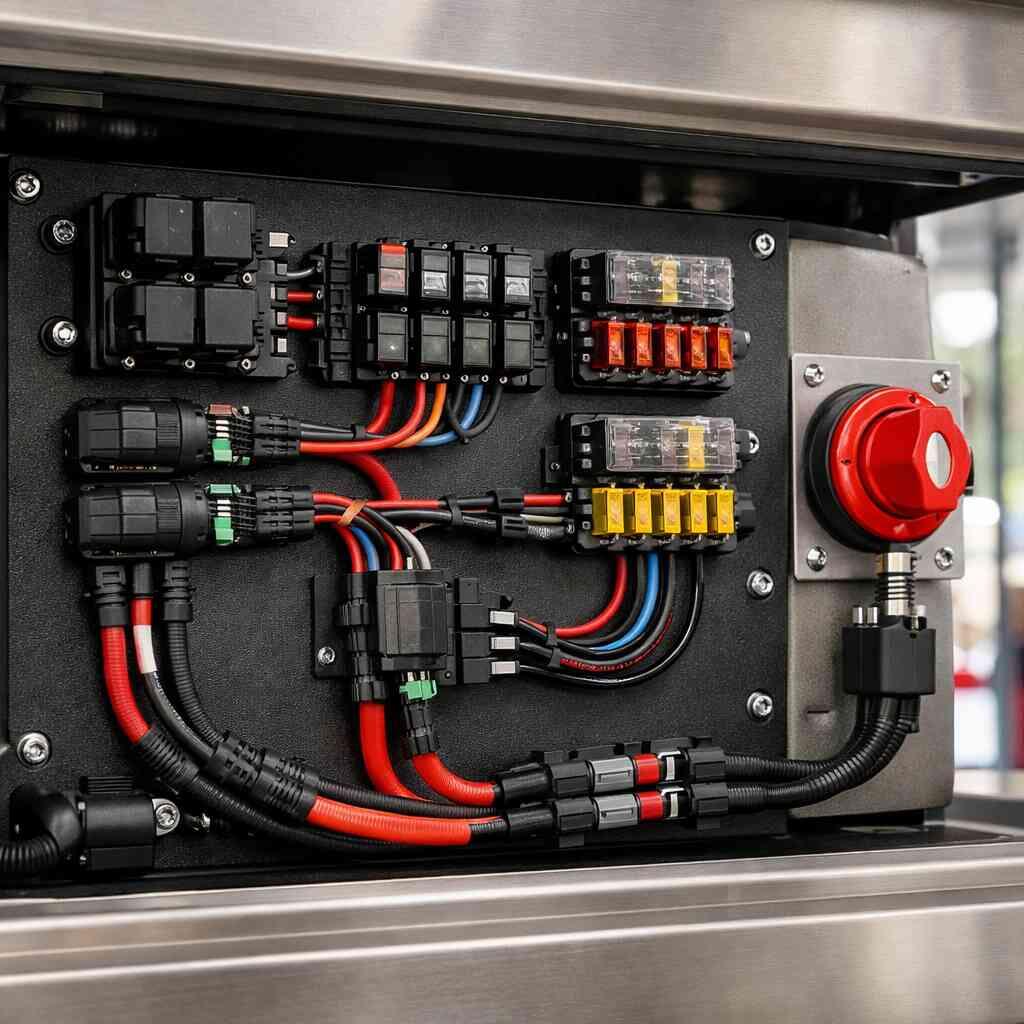
The Difference Between UL 1977 and IP68 for 2026
August 22, 2026
Why a connector that looks sealed can still fail under fireground conditions
A connector can look rock solid and still fail you. That is the part most people miss. If you are dealing with moisture, grit, and vibration after a long shift, the uncertainty is real. You need more than a clean exterior. You need the right standard for the job.
The hidden gap between a UL 1977 electrical connector certification and an IP68 ingress protection rating
The UL 1977 connector standard and the IP68 ingress protection rating answer different questions. UL 1977 focuses on electrical connector certification and related safety compliance. IP68 focuses on water and dust protection at the enclosure or sealing level. Those are not interchangeable. A connector can satisfy one and still leave gaps in the other.
That gap matters on fireground equipment. A connector may survive routine handling, yet still struggle after repeated hose-downs, heat, and contamination. We hear this concern often from crews who want certainty, not theory. Here is the part most people miss: a rating can describe a condition, but not the whole operating environment. If you are comparing UL 1977 vs IP68, you should compare the actual failure mode first.
One crew in central Florida described a system that looked perfect after installation. Then small moisture intrusion started showing up after washdowns and roadside dust. Nothing dramatic happened on day one. The failure came later, after vibration and corrosion had time to work. That kind of problem rarely announces itself early.
Why hose-down resistant connectors and submersible connector ratings do not mean the same thing
Hose-down resistant connectors and a submersible connector rating are not the same. Hose-down resistance usually refers to water exposure from cleaning or spray. Submersion implies a much harsher condition. The distinction sounds small until you are the one troubleshooting a wet control circuit.
This is where connector test methods matter. A design that handles spray may not handle pressure, duration, or depth the same way. You may also see different results once temperature shifts and sealing materials begin to move. Water behaves differently under pressure, especially around seams, backshells, and cable exits. That is why connector sealing performance needs more than a label.
For emergency response hardware, confusion here can be expensive. If your equipment gets cleaned hard after every run, the connector must tolerate repeated exposure. If it ever sits in standing water, the demands rise again. In practice, the issue is often not the face of the connector. It is the path water finds behind it.
The most common field-deployable equipment connectors mistake when moisture, dust, and vibration stack up
The most common mistake is assuming a single rating solves every problem. It does not. Moisture ingress protection, dust-tight enclosure protection, and vibration resistance all interact. If one weak point fails, the entire system suffers. That is why field-deployable equipment connectors need a system-level view.
People often choose a connector based on the highest-numbered label. That sounds smart. It can be misleading. A connector may be strong in one dimension and only average in another. For ruggedized power connections, the real question is not, “What is the rating?” The real question is, “What does the assembly survive after months of use?”
In our experience, the biggest mistake is ignoring the cable side. Cable strain relief, jacket compatibility, and termination quality can undo a strong connector body. Dust and vibration then finish the job. If the assembly was not built for harsh environment connectivity, the rating becomes less useful than it looked on paper.
What UL 1977 actually tells you about electrical interconnect standards
UL 1977 is more than a badge. It is part of a broader conversation about electrical interconnect standards and connector safety compliance. If you use power and control connections in tough conditions, this standard helps frame baseline expectations. It does not, however, tell you everything about outdoor abuse. That distinction keeps buyers from overestimating what the marking means.
What the UL 1977 connector standard is designed to evaluate in ruggedized power connections
The UL 1977 connector standard for rugged electrical interconnects is designed to evaluate how a connector performs from a safety standpoint. That includes concerns tied to electrical integrity, construction, and misuse scenarios. It helps confirm that a connector is not just convenient. It is built to meet defined safety expectations under recognized conditions. That matters when the equipment sits close to people and critical systems.
For fire service equipment connectors, that safety lens is important. You are not just asking whether the connector fits. You are asking whether the design supports dependable operation under demanding use. The standard helps buyers evaluate ruggedized power connections with more confidence. Still, it does not automatically equal waterproof performance or full environmental protection standards.
A technician recently told us about a truck bay where connectors stayed electrically sound but suffered from exterior contamination. The issue was not instant failure. It was gradual degradation that made troubleshooting harder every week. That is a classic lesson from the field. Safety compliance and environmental survivability overlap, but they are not identical.
How UL listed connector requirements relate to safety compliance rather than full environmental protection standards
UL listed connector requirements are valuable because they support safety compliance. They help set expectations for construction and electrical behavior. Yet they do not replace every test a harsh-duty product should face. That is the subtle difference many teams overlook. It is also why spec sheets deserve close reading.
If your application faces washdowns, road grime, and temperature swings, you need to look beyond the listing. You may need dust-tight and moisture-resistant connector protection testing in addition to safety listing information. You may also need to consider connector material compatibility. Plastics, seals, and metallic parts can age differently under stress. What worked indoors may not behave the same outside.
Think of UL 1977 as a foundation, not the entire structure. It gives you a dependable reference point. It does not excuse you from evaluating the rest of the assembly. That is especially true for high-demand electrical applications where downtime is not a minor inconvenience. It can disrupt response readiness.
Where UL 1977 fits in connector selection guide decisions for fire service equipment connectors
A good connector selection guide starts with the job, not the marketing language. UL 1977 helps narrow the field when you need a safe electrical connection. Then you layer in the environment. Heat, washdown, dust, vibration, and corrosion all matter. That is the practical way to think about fire service equipment connectors.
For teams comparing options, this decision often becomes a matrix. Use the table below as a simple filter.
FactorUL 1977 tells youWhat you still need to confirmElectrical safetyBaseline construction and safety complianceApplication-specific abuse toleranceMoisture exposureLimited direct answerSealing, cable entry, and cleaning exposureDust exposureLimited direct answerIngress protection and assembly designVibrationNot the main focusRetention, strain relief, and installation qualityThat table is simple on purpose. It helps teams separate connector safety compliance from environmental resilience. If you are comparing fire service equipment connectors, this distinction saves time. It also keeps you from assuming a label covers every condition your crew actually faces.
Why IP68 sounds stronger than it is and where it stops answering the real question
IP68 sounds decisive. It feels like a promise. But a strong-sounding number is only useful if you know what it measures. That is especially true for sealed electrical systems. The rating may impress at first glance, yet still leave open questions about real-world durability.
What the IP68 ingress protection rating does and does not verify in sealed electrical systems
The IP68 ingress protection rating describes protection against dust and water under defined test conditions. It is one of the most recognized waterproof connector rating references. However, it does not tell you everything about electrical performance. It does not automatically prove long-term reliability under repeated abuse. That gap matters in emergency response hardware.
IP68 is useful because it speaks to ingress protection comparison in a clear way. It can indicate that a design resists dust and certain moisture conditions well. But it does not answer every field question. It does not fully describe connector life after repeated mating cycles, chemical exposure, or cable movement. Those issues belong to the broader system.
What we have seen in 2026 specifically is that buyers often assume IP68 equals “no worries.” That is not fair to the standard. It is simply incomplete. If the installation is poor, the seal can still fail. If the materials are mismatched, the benefits shrink.
How dust-tight enclosure protection and moisture ingress protection are measured differently from electrical safety
Dust-tight enclosure protection and moisture ingress protection are environmental measures. Electrical safety is a different category. One tells you how well contaminants stay out. The other tells you how the connector behaves as an electrical component. Those are related, but they are not the same. A connector can score well on ingress and still create issues if the assembly is stressed. Likewise, a connector can be electrically safe and still be vulnerable to wet conditions. That is why connector performance verification should include both categories when possible. You want confidence in the seal and confidence in the circuit. Leaving one out is how surprises happen.
A municipal fleet manager once described a recurring problem after post-shift washdowns. The equipment looked dry externally, but trouble appeared at the cable interface. The root cause turned out to be assembly details, not the front face of the connector. That is a hard lesson, because it means the answer is rarely one feature. It is the whole design.
Why connector sealing performance can still depend on cable assembly protection and material compatibility
Connector sealing performance depends heavily on cable assembly protection. The gland, jacket, and strain relief all matter. Material compatibility matters too. Some combinations age well together. Others harden, crack, or lose compression over time. That is especially relevant in Florida heat and humidity.
If the sealing system and cable jacket are not matched correctly, IP68 may not deliver the real-world durability you expect. This is where connector material compatibility becomes crucial. The connector body can be rated well, but the cable exit may become the weak spot. And once water or debris finds that path, the whole assembly becomes vulnerable.
For that reason, IP68 ingress protection rating for waterproof connector performance should be read as one part of a broader decision. It is valuable. It is not magic. If you are specifying sealed electrical systems for hard use, always ask how the cable assembly was tested, how the materials interact, and how repeated service will affect the seal.
When UL 1977 vs IP68 becomes a make or break decision in the field
The decision becomes urgent when the equipment leaves the bench and enters daily service. That is where the labels stop feeling abstract. Washdowns happen. Debris gets everywhere. Corrosion starts quietly. Then the question shifts from “What does the spec say?” to “What does the truck need to keep running?”
Choosing weatherproof connection solutions for emergency response hardware exposed to washdowns and debris
Weatherproof connection solutions for DeLand, Florida, fleets must account for more than a single exposure type. High-pressure cleaning, coastal moisture, and roadway dust all show up differently. In and around Volusia County, that reality is hard to ignore. Equipment that works in a dry bay can behave differently after repeated cleaning and real-world wear.
This is where the choice between UL 1977 vs IP68 for fire truck connector selection becomes practical. If the main concern is safety compliance, UL 1977 may be central. If water intrusion is the main concern, IP68 matters more. Many applications need both perspectives. The best choice depends on the actual operating environment, not the best-looking marketing term.
We have seen teams make progress by listing the top three threats first. Try this:
- water exposure from washdowns
- dust and debris from the road
- vibration from daily driving and pump operation
That short list usually clarifies the direction fast. It is not glamorous. It is effective.
What matters most for high-demand electrical applications where corrosion resistance in connectors is a constant threat
Corrosion resistance in connectors is one of the hardest realities in Florida. Salt air, rain, humidity, and cleaning chemicals all work together. Even if you are inland, moisture still finds a path. That is why high-demand electrical applications need more than a hopeful assumption. They need intentional design.
Connector test methods should reflect the environment. Ask how the product handles repeated exposure, not just one ideal lab condition. Ask about corrosion resistance in connectors as part of the assembly, not only the shell. Ask how the manufacturer addresses termination quality and cable entry protection. Those questions often reveal more than the rating itself.
Here is the truth many guides skip. A connector that survives one season may still become a maintenance burden later. The issue is not always a dramatic failure. Sometimes it is intermittent loss, nuisance alarms, or hard-to-trace resistance changes. That is why industrial connector durability has to be judged over time, not just at installation.
How first responder equipment reliability changes the way teams think about connector performance verification
First responder equipment reliability changes the standard. You do not get many chances to learn from failure. That is why teams think differently about connector performance verification than a commercial buyer might. A delayed response, a dead control line, or a corroded contact is not a minor defect. It is a readiness issue.
On the projects we have finished this year, the most careful teams ask for proof that the connector system matches the job. They want the standard. They want the seal. They want the cable details. That mindset reflects real operational pressure. It also reflects respect for the equipment and the people relying on it.
If you are comparing electrical connector certification options, think in layers:
- Confirm the electrical safety baseline.
- Confirm moisture and dust resistance.
- Confirm material and cable compatibility.
- Confirm how the assembly behaves after service use.
That sequence keeps you grounded. It also keeps you from overvaluing one impressive-sounding rating.
The next move that protects your equipment before the next call comes in
The smartest move is to match the standard to the actual duty cycle. That sounds simple because it is. The hard part is being honest about the conditions. Once you do that, the decision gets clearer. The rest is just disciplined evaluation.
A practical connector selection guide for matching UL 1977 IP68 or both to the application
A practical connector selection guide should start with exposure, then move to function. Ask what the connector must survive, not only what it must power. Then compare UL 1977, IP68, or both against those needs. That keeps the decision useful instead of theoretical. It also helps avoid overspecifying in the wrong direction.
Use this quick checklist:
- Define the electrical load and safety expectations.
- Define water exposure, including washdowns and standing moisture.
- Define dust, vibration, and corrosion risk.
- Confirm the cable assembly protection plan.
- Verify material compatibility across the full assembly.
If you are working through fire truck cabling and connector performance verification, this checklist helps separate nice-to-have features from real needs. It also gives your team a cleaner conversation with the manufacturer. The more clearly you define the use case, the better the recommendation. That is true for new builds and retrofit work alike.
How to evaluate fire service equipment connectors without assuming every sealed electrical system is equally durable
Every sealed electrical system is not equally durable. That statement saves people time and money. A system can be sealed, yet still be weak in the wrong place. It can be rated, yet still be poorly suited to repetitive service. The difference often shows up months later.
Start by looking for the weak link. Is it the connector face, the cable entry, the jacket, or the installation method? Then ask how the system was validated. If someone cannot explain the test methods clearly, slow down. A good product should make its logic easy to follow. A good supplier should welcome those questions.
For fire service equipment connectors, durability is not a slogan. It is the sum of many details working together. That includes connector sealing performance, corrosion resistance, and repeatable installation quality. If one part is weak, the whole assembly feels it.
When to review dependable fire equipment connections with a manufacturer like Fire Power Products in DeLand, Florida
If you are weighing dependable fire equipment connections, review the full application with a manufacturer that understands the environment. Fire Power Products in DeLand, Florida, focuses on equipment durability in demanding conditions. That local perspective matters because Florida weather is not gentle. Heat, humidity, and storm exposure change the conversation fast. A good review can uncover issues before they become field failures.
You do not have to figure this out alone, and you do not have to solve every detail today. Start with one call, one spec sheet, and one honest conversation about exposure. Ask how the connector will be used, cleaned, and maintained. Then compare that answer to the standard, not the marketing. That is how you protect the next call before it arrives.
Frequently Asked Questions
Question: What is the difference between the UL 1977 connector standard and the IP68 ingress protection rating for fire service equipment connectors?
Answer: The UL 1977 connector standard and the IP68 ingress protection rating evaluate different risks, so they should not be treated as interchangeable. UL 1977 is primarily tied to electrical connector certification and connector safety compliance, while IP68 focuses on dust-tight enclosure protection and moisture ingress protection under defined test conditions. For high-demand electrical applications, that means one rating may support the electrical side while the other addresses environmental exposure. At Fire Power Products in DeLand, Florida, the right approach is to look at the full operating environment first: washdowns, dust, vibration, and corrosion resistance in connectors. That is the practical way to evaluate UL 1977 vs IP68 without assuming a single label solves every problem.
Question: In The Difference Between UL 1977 and IP68 for 2026, why do hose-down resistant connectors and a submersible connector rating not mean the same thing?
Answer: Hose-down resistant connectors are typically designed to handle spray, cleaning, and routine water exposure, while a submersible connector rating implies much harsher conditions. The difference matters because connector sealing performance can change depending on pressure, duration, depth, and how the cable assembly is built. A connector may perform well during washdowns but still fail if standing water, repeated cleaning, or cable movement stresses the sealing system. Fire Power Products evaluates these distinctions carefully because dependable fire equipment connections depend on the whole assembly, not just the front face of the connector. For teams comparing waterproof connector rating options, the key is to match the connector test methods to the actual use case, not just the highest-sounding number.
Question: How can UL listed connector requirements help with connector safety compliance without replacing full environmental protection standards?
Answer: UL listed connector requirements are valuable because they establish a recognized baseline for electrical safety and construction. That makes UL 1977 an important part of evaluating ruggedized power connections and other electrical interconnect standards. But it does not replace environmental protection standards such as IP68, nor does it fully predict industrial connector durability under washdowns, dust, vibration, and chemical exposure. In practice, the best connector selection guide looks at both safety and environment together. Fire Power Products helps customers think through those layers so they can choose field-deployable equipment connectors that align with real-world conditions rather than relying on a single certification alone.
Question: What should buyers confirm beyond IP68 when choosing sealed electrical systems for emergency response hardware?
Answer: Buyers should confirm the full assembly, not just the IP68 ingress protection rating. That includes connector material compatibility, cable assembly protection, strain relief, termination quality, and how the system behaves after repeated service use. IP68 can indicate strong moisture ingress protection and dust-tight enclosure protection, but it does not automatically guarantee long-term reliability in harsh environment connectivity. For emergency response hardware, the cable exit is often where problems begin, especially when vibration and corrosion resistance in connectors are part of the daily challenge. Fire Power Products encourages a complete connector performance verification review so customers can better understand what the assembly will actually survive in the field.
Question: How should a team apply the connector selection guide when deciding between UL 1977 IP68 or both for high-demand electrical applications?
Answer: A practical connector selection guide starts with the environment, then moves to the electrical requirements. Teams should define water exposure, dust exposure, vibration, cleaning methods, and corrosion risk before comparing UL 1977 IP68 or both. If the application requires connector safety compliance and strong moisture resistance, the best answer may be to consider both ratings together. If the exposure is lighter, one standard may be enough, but only after the full duty cycle is understood. Fire Power Products, based in DeLand, Florida, takes this same systems-based approach to dependable fire equipment connections because first responder equipment reliability depends on more than a single spec. The goal is to choose weatherproof connection solutions that fit the real job, not just the marketing language.
Question: How does Fire Power Products help evaluate fire service equipment connectors for industrial connector durability and long-term performance?
Answer: Fire Power Products helps by focusing on the complete application, including connector test methods, cable assembly protection, and the realities of daily use in tough conditions. That matters because industrial connector durability is shaped by the connector body, the cable side, the sealing interface, and installation quality. A connector can look strong on paper yet still develop issues from moisture ingress, vibration, or corrosion resistance in connectors over time. For teams comparing fire service equipment connectors, the best path is to review the environment honestly and confirm the product matches those conditions before installation. Fire Power Products supports that process with an expert, reliability-focused approach rooted in demanding fire safety equipment use cases.