Why Do Fire Truck Connectors Fail During Hose Downs
November 1, 2026
Fire truck connectors usually fail during hose downs because water finds weak points that look fine from the outside: degraded seals, loose pins, cracked housings, and worn strain relief. A connector can survive normal service for years and still short the moment high-pressure water, soap, and heat expose hidden damage. If you are dealing with that kind of intermittent trouble, you are not imagining it.
Key Takeaways
- Hose down water intrusion often starts at the seal, gasket, or pin interface, not the outer housing.
- Electrical connector shorting after a washdown usually reflects hidden wear, corrosion, or loosened terminals that built up over time.
- Vibration-induced connector loosening and strain relief issues make failures intermittent, which is why they are easy to miss in routine inspections.
- Thermal cycling connector stress can open tiny gaps in weatherproof fire equipment connectors, then cleaning water turns those gaps into failures.
- A better fix is usually inspection of fire truck connectors, targeted replacement, and stronger fire truck wiring harness protection rather than repeated drying and resetting.
Why a fire truck connector can look fine and still fail the moment the hose goes down
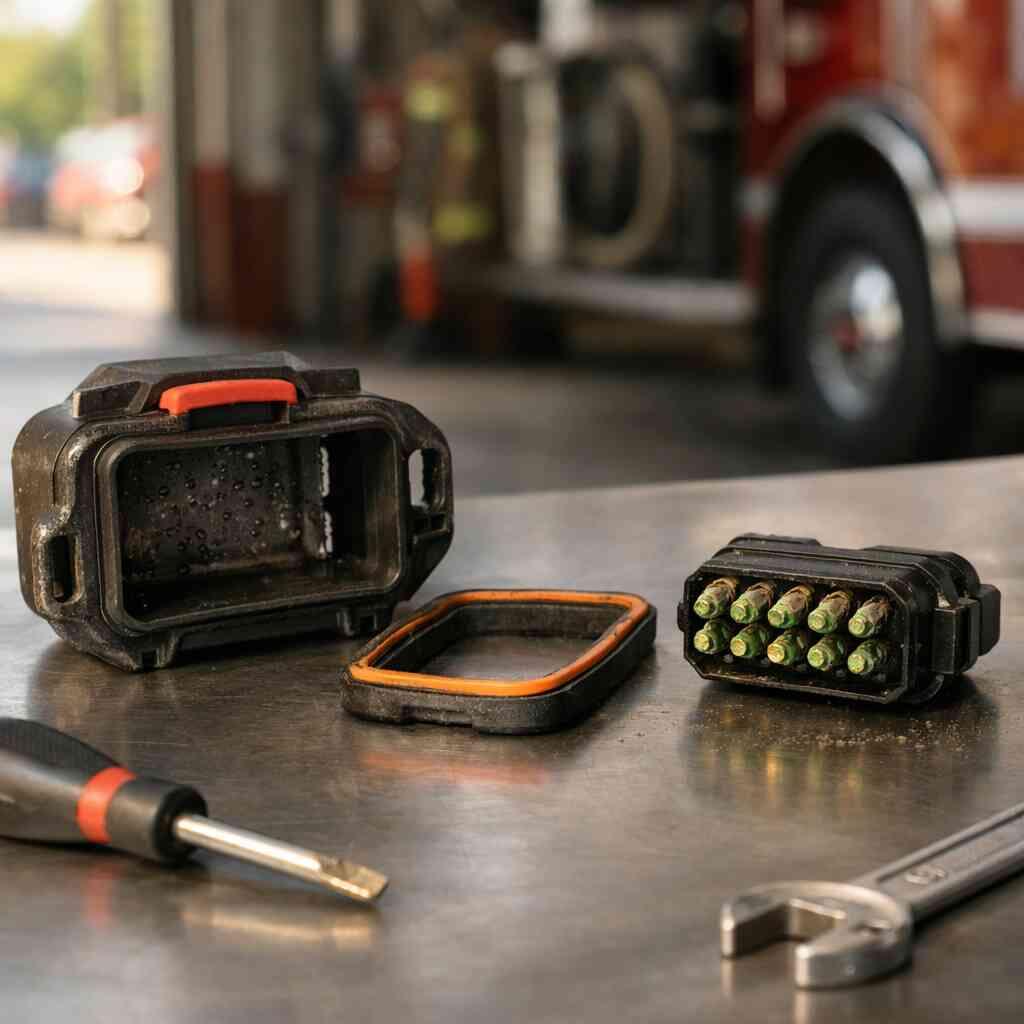
A connector can appear intact and still fail because water intrusion usually begins inside the sealing surfaces, not on the visible shell. Once a gasket hardens, a pin loosens, or the housing flexes, high-pressure water can create water ingress in fire truck connectors and trigger water spray electrical failure even when the outside looks normal. That is why these failures often feel sudden.
How water intrusion starts at the seal, gasket, or pin interface even when the housing looks intact
The first weak point is often the smallest one. A connector seal may have a slight compression set, a gasket may no longer sit evenly, or a pin interface may have enough wear to let moisture wick inward. That leads to connector seal degradation and eventually connector terminal oxidation, especially when the truck lives in a wet bay or sees frequent exterior washdowns.
Here is the part most people miss: a connector does not need to be visibly broken to fail. A slight gap, a tiny nick in the seal, or a few specks of contamination can create a path for hose down water intrusion. Once water reaches the terminals, the problem can move from nuisance to shutdown fast.
We have seen this pattern on apparatus that looked serviceable until the first hard wash exposed the defect. The connector passed a glance test. It did not pass a water test. That is why inspection of fire truck connectors has to be more than a quick look.
Why pressure washing and apparatus bay washdown can trigger electrical connector shorting after years of hidden wear
Pressure washing does not always create the damage. Often, it reveals it. Years of heat, vibration, and minor contamination weaken the connector first, and then apparatus bay washdown damage or a pressure rinse finishes the job. If the connector already has loose terminals or cracked sealing surfaces, the wash water becomes the trigger for electrical connector shorting.
The mechanism is simple. High-pressure spray forces moisture into places normal rain cannot reach. If the connector housing has lost integrity, the water can bridge pins, carry dirt into the cavity, or push chemicals deeper into the contact area. That is why high-pressure wash exposure is so hard on aging equipment.
A technician once described a unit that failed only after a full exterior cleaning, not after road miles or emergency runs. That is common. Cleaning did not cause the weakness. It exposed it.
What every fire apparatus technician misses about hose down connector damage
Technicians often inspect the wrong symptom. They check the connector after it fails, but the real cause started earlier with movement, heat, and contamination. Fire apparatus connector maintenance has to account for looseness, strain, and thermal stress, or you keep chasing the same intermittent fault.
How vibration-induced connector loosening and strain relief issues turn routine use into intermittent failure
A connector that is not properly supported will move. Over time, vibration works the terminals loose and weakens the strain relief. That creates vibration-induced connector loosening and connector strain relief issues, which may only show up when the truck shakes on the road, then settles during washdown. The failure pattern is frustrating because it comes and goes. One day the light works. The next day it does not. Then it comes back after you wiggle the harness. That behavior often points to a marginal pin fit, a partially backed-out terminal, or a connector body that no longer locks tightly. A good inspection includes more than continuity testing. It should include:
- tug checking the harness at the connector body
- verifying lock engagement
- looking for backed-out pins
- checking for cracked retainers
- confirming the harness is not carrying load at the connector
If the harness is pulling on the connector, the failure is already in motion. Strong fire truck wiring harness protection starts with support, not just sealing.
Why thermal cycling connector stress, corrosion, and pin contamination often show up only after cleaning begins
Heat and cold expand and contract materials at different rates. That repeated movement creates thermal cycling connector stress, which can open microscopic paths for moisture and contamination. Once corrosion starts, a washdown can dislodge particles and push them into the pin cavity, making the issue suddenly visible.
Connector pin contamination is especially deceptive. A pin can still make contact during dry conditions, then fail when water, soap residue, or road film gets involved. That is why a connector may test fine on the bench and still short in the field after cleaning.
For deeper reference on connector selection and maintenance, Fire Power Products has a useful guide to connector maintenance and a connector check list that align with field inspection habits. They are not substitutes for hands-on diagnosis, but they help frame what to look for. You can also review what IP68 testing means for fire truck connectors for more context on sealing performance.
The failure chain that turns moisture resistant connectors into a repair call
A moisture-resistant connector can still fail if corrosion, oxidation, and seal wear stack up together. The failure is rarely one thing. It is usually a chain reaction that turns a weatherproof design into a repair call after the truck gets wet, cleaned, and put back into service.
How firefighting equipment corrosion, terminal oxidation, and connector seal degradation work together inside weatherproof fire equipment connectors
The slowest damage is usually the most dangerous. Firefighting equipment corrosion begins as surface discoloration, then advances to contact resistance, heat buildup, and finally intermittent operation. As that process continues, connector terminal oxidation and connector seal degradation reinforce each other inside otherwise weatherproof fire equipment connectors.
A simple way to think about it is this:
Failure factorWhat it doesWhat you noticeCorrosionIncreases resistance at the contact pointDim lights, erratic signals, heat at the connectorTerminal oxidationReduces conductivity on the metal surfaceIntermittent faults that return after movementSeal degradationLets moisture and contaminants insideShorting after hose downs or wash baysThat chain explains why moisture-resistant connectors are not the same as maintenance-free connectors. They resist exposure better, but they still need inspection, cleaning, and replacement when seals or terminals are compromised. For design comparison, Fire Power Products also provides an UL-rated connector overview and a Florida connector specs guide.
Where fire truck wiring harness protection breaks down when salt, chemicals, and high-pressure wash exposure hit the same weak point
The worst failures happen when three things meet at once: salt, cleaning chemicals, and wash pressure. That combination is especially harsh on corrosion-resistant electrical components if the harness is already compromised. Salt and chemical exposure corrosion can attack the terminals, while spray pressure drives contaminants into the same weak point again and again.
This is where fire truck wiring harness protection often breaks down. The connector may be located near a wheel well, bumper area, or lower compartment edge where it gets blasted repeatedly. If the harness clamp is missing, the seal is aging, and the connector housing integrity is already marginal, the next washdown can become the failure point.
One fleet manager told us their issue only appeared after bay cleaning, not after service calls. The culprit turned out to be a connector sitting low enough to catch rinse water every time the rig came back in. The fix was not a temporary dry-out. It was replacement, rerouting, and better support.
If you are deciding whether to repair or replace, it helps to compare options against harsh-environment demands. Fire Power Products has a fire truck connector resource and a broader electrical connector guide that can help you think through ruggedized fire truck connectors for repeated wash exposure.
The practical takeaway is straightforward. If a connector has failed once after a hose down, assume the surrounding system may be compromised too. Check the pins, the seal, the harness support, and the moisture path. A single repair may not solve a systemic weakness, especially in rigs that see frequent washdowns, Florida humidity, and constant service use.
For durable, USA-made connectors and fireground electrical systems built for harsh hose-down conditions, Fire Power Products is a strong option to review alongside your maintenance plan. If you need help matching the right connector approach to your apparatus, call 369-279-000 and ask about components designed for demanding fire truck electrical system protection. You do not have to solve it all today. Start with one inspection and one call.
Frequently Asked Questions
Question: Why do fire truck connector failure issues often show up after hose down water intrusion instead of during normal operation?
Answer: Hose down water intrusion often exposes weaknesses that have been developing quietly over time. Degraded seals, connector gasket failure, loose terminals, connector pin contamination, and worn strain relief can all let moisture reach the contact area during a washdown even if the connector looked fine before. Once water gets inside, electrical connector shorting or water spray electrical failure can happen quickly. In many cases, the real issue is not the washdown itself, but a combination of firefighting equipment corrosion, thermal cycling connector stress, and vibration-induced connector loosening that has already reduced the connector’s margin of safety. Fire Power Products focuses on durable, USA-made solutions designed for harsh-environment connector performance, but any connector still needs regular inspection of fire truck connectors and proper fire truck wiring harness protection to stay reliable.
Question: What should be checked first during fire apparatus connector maintenance after an apparatus bay washdown damage complaint?
Answer: The first checks should focus on the most common failure points: connector housing integrity, seal condition, terminal fit, and harness support. A quick visual inspection is not enough. Look for connector seal degradation, cracked housings, backed-out pins, signs of connector terminal oxidation, and any evidence of moisture in the cavity. It is also important to check for vibration-induced connector loosening and connector strain relief issues, because a connector that is physically stressed can fail intermittently before it fails completely. If a rig sees repeated cleaning, salt and chemical exposure corrosion can also accelerate damage. Fire Power Products recommends a careful troubleshooting approach rather than repeated drying and resetting, since that can hide the root cause instead of fixing it.
Question: How does the blog Why Do Fire Truck Connectors Fail During Hose Downs relate to ruggedized fire truck connectors and sealed connector systems?
Answer: The blog explains that hose down connector damage usually results from a chain of small issues, not a single event. Ruggedized fire truck connectors and sealed connector systems are designed to better handle moisture, vibration, and cleaning exposure, but they still depend on good installation and preventive maintenance for fire trucks. If the seal is worn, the housing is stressed, or the harness is pulling on the connector, even a moisture-resistant connector can eventually fail. That is why the article emphasizes inspection of fire truck connectors, fire truck electrical system protection, and correcting the surrounding conditions instead of assuming a weatherproof connector will solve every problem by itself. Fire Power Products aligns with that practical approach by offering hardware intended for demanding service conditions, while keeping maintenance and troubleshooting part of the long-term solution.
Question: Should dielectric grease for connectors be used when protecting fire truck wiring harness protection during washdowns?
Answer: Dielectric grease for connectors can be helpful in some applications, but it should never be used as a substitute for proper connector design, clean terminals, and correct sealing. It may help reduce moisture intrusion and slow connector terminal oxidation in certain environments, but if the connector already has connector pin contamination, a damaged gasket, or compromised housing integrity, grease alone will not solve the problem. The best practice is to inspect the connector, verify fit and sealing, and confirm the harness is supported so there is no stress on the terminals. For fire apparatus electrical troubleshooting, the surrounding system matters just as much as the connector itself. Fire Power Products encourages a maintenance-first approach that supports long-term hose wash equipment reliability instead of relying on one product or one quick fix.
Question: What makes corrosion-resistant electrical components important for fire apparatus connector maintenance in harsh environments?
Answer: Corrosion-resistant electrical components matter because fire trucks are exposed to water, soap, humidity, road grime, heat, and sometimes salt and chemical exposure corrosion all in the same service life. Over time, those conditions can cause firefighting equipment corrosion, connector terminal oxidation, and connector seal degradation. A connector that survives one washdown may still be developing hidden resistance or intermittent faults if the contact surfaces are deteriorating. Choosing better materials is only part of the answer, though. You also need regular inspection of fire truck connectors, proper harness routing, and attention to connector housing integrity so the system is not mechanically stressed. Fire Power Products, based in DeLand, Florida, is positioned around durability and harsh-environment connector performance, which makes that preventive mindset especially relevant for departments that need dependable fire truck electrical system protection.
Question: How can Fire Power Products help when a department keeps seeing water ingress in fire truck connectors after repeated cleaning?
Answer: When water ingress in fire truck connectors keeps returning, the fix usually involves more than replacing one part. The whole failure path needs to be examined: the connector seal, the pin interface, the harness support, exposure location, and whether high-pressure wash exposure is hitting the same weak point every time. Fire Power Products can help by supplying durable connector solutions intended for tough service conditions, but the most effective result comes from pairing the right hardware with preventive maintenance for fire trucks. That means checking for connector gasket failure, reworking harness routing, and replacing compromised connectors rather than repeatedly drying them out. If you are trying to improve hose wash equipment reliability and reduce electrical connector shorting, a thorough inspection and the right replacement strategy are often more effective than temporary fixes. For questions about matching the right approach to your apparatus, you can reach out to Fire Power Products in DeLand, Florida at 369-279-000.


