Top 5 OSHA Ready Inspection Steps for DeLand Fleet Bays 2026
September 22, 2026
-
The walkthrough that catches OSHA problems before the first truck rolls
If you are reading this because an inspection feels close, take a breath. That tension is real. Most fleet managers do not worry about the tool bench first; they worry about what a state or municipal inspector sees in the first ten seconds. That instinct is right. The cleanest OSHA-ready fleet bay inspection steps in DeLand start at the entrance lane, because the entrance reveals traffic flow, housekeeping, and obvious risk before anyone studies paperwork. In DeLand, Florida, where afternoon storms, tracked-in moisture, and heavy turnover can compound fast, the threshold matters more than people think.
Why a DeLand fleet bay inspection needs to start at the entrance lane and not the tool bench
Start where trucks enter, not where wrenches live. That is the simplest rule, and it saves time. The lane tells you whether the bay is organized for actual work or just staged for appearances. You can see blocked sightlines, poor industrial safety signage, and awkward first responder equipment staging within moments. If a vehicle has to thread past cones, carts, or hoses, the inspection story is already speaking loudly.
Here is the part most supervisors miss. OSHA does not care that the clutter is temporary if it creates a predictable hazard. A good DeLand fleet bay compliance review should ask one question first: can a driver move safely without improvising? If the answer is no, your correction list just got longer. On the projects we have finished this year, that first impression has often exposed deeper maintenance issues, especially near the entrance where repairs, deliveries, and foot traffic collide.
How to spot slip trip and fall prevention issues in the first thirty seconds of a bay walkthrough
Watch the floor before you watch the equipment. That simple habit catches many slip, trip, and fall prevention failures immediately. Wet patches, loose mats, uneven thresholds, and cords crossing walk paths all show up quickly. So do worn anti-slip flooring conditions that look fine when dry but become slick during hose-down use. If your bay serves emergency apparatus, the margin for error is small.
A quick inspection should also include a boots-on-the-floor test. Walk the same path a technician would take while carrying parts, not while empty-handed. That perspective matters. It reveals whether floor transitions, drain covers, and painted walk lines help or hinder movement. If you have ever watched someone shuffle sideways around a hose cart, you know the problem is not theoretical.
Which housekeeping mistakes usually signal deeper fleet maintenance safety checklist failures
Housekeeping problems rarely stay small. Loose fasteners on the floor, oily rags near storage, and trash collecting under benches often point to a weak fleet maintenance safety checklist. Those details may seem minor, but they usually reveal bigger habits. For example, if a bay allows parts to accumulate in shared space, tool storage and rack safety may also be weak. If the floor is never reset, nobody owns the reset.
A vehicle bay housekeeping standards and bay organization review should look for rhythm, not just cleanliness. Are spills handled immediately? Are tools returned to fixed places? Are carts parked out of emergency paths? A bay that answers yes to those questions usually has better discipline everywhere else. A bay that answers no usually has problems hiding behind the next service ticket.
Where first responder equipment staging can create blocked paths and avoidable exposure points
Staging matters because speed matters. But speed without order creates blocked paths and avoidable exposure points. A charger, hose bundle, or spare cylinder placed too close to an aisle can turn a normal day into a citation risk. It can also slow response when seconds matter. The safest bays define where gear waits and where people move.
One municipal shop we observed had a simple problem with a complicated effect. A stack of staged absorbent bins sat near the only clear exit path, and nobody noticed until a routine walkthrough. The bins were harmless alone. Together with a parked dolly and an open cabinet door, they created a narrow squeeze point right where people turned with equipment in hand. Fixing that one layout issue improved flow immediately.
-
The floor, drains, and spill zones that quietly decide compliance
Floors tell the truth. So do drains. If you want a fleet bay compliance check that feels practical instead of academic, start where fluids land and where workers stand. In wet service environments, especially around diesel fuel, oil, and hydraulic fluid, the floor is not background. It is the control surface for safety. That is why spill containment for fleet bays deserves the same attention as lift equipment and electrical panels.
What anti-slip flooring conditions should look like under heavy-duty fleet bay workflow
Good flooring should still work when the bay is busy. It should hold traction under washdown, resist oil film, and stay readable under traffic. Heavy-duty fleet bay workflow exposes every weak patch. Cracks collect grime. Glazed surfaces lose grip. Painted stripes fade into the surrounding wet concrete and stop guiding anyone.
You do not need perfect flooring to pass an inspection. You need flooring that performs predictably. The key is consistency. If one area dries fast and another stays slick, you have an operational imbalance. A supervisor should spot that during a normal walk, not after a near fall. Slip trip and fall prevention begins with honest floor conditions, not wishful thinking.
How spill containment for fleet bays changes when diesel fuel oil or hydraulic fluid is present
Fluids change the math. Diesel spreads. Hydraulic fluid clings. Oil hides in texture and keeps a floor dangerous long after the spill appears handled. That is why spill containment for fleet bays with hose-down crews needs defined procedures, not just absorbents on a shelf. The response should match the fluid, the bay surface, and the cleanup method.
A good containment plan includes clear staging, fast access, and a place for contaminated materials. If hose-down crews are active, the plan must also account for runoff paths. In humid Central Florida conditions, moisture lingers, which makes residue harder to see. The mistake we see most often is treating every spill the same. They are not the same, and your cleanup pattern should prove you understand that.
When floor drain maintenance compliance becomes a liability instead of a routine task
Drains are easy to ignore until they back up. Then they become impossible to ignore. Floor drain maintenance compliance is not just about removing debris. It is about confirming that drains function as designed, that screens are intact, and that standing water does not migrate into walking lanes. When a drain is slow, every rinse cycle becomes a new hazard.
On one recent bay review, a drain near a wash area looked fine from above. A closer inspection showed buildup underneath the grate and a recurring damp ring across the traffic lane. That was enough to explain the slippery patch technicians had been blaming on weather. Once the maintenance team addressed the drain and adjusted cleanup timing, the hazard dropped fast. Sometimes the problem is not the floor at all. It is the floor’s drainage partner.
Why wet hose washdown areas need a tighter cleaning pattern in humid Central Florida conditions
Wet areas need more discipline, not less. Humid Central Florida keeps surfaces damp longer, especially after hose-down work and open-door ventilation. That means cleaning cannot end with a visual sweep. It must include drying, edge checking, and a final pass through the routes most people take with tools or parts. Otherwise, the same water keeps becoming the same incident.
A tighter pattern should also protect the adjacent work zones. Do not let water drift under stored equipment or into battery areas. Do not leave sludge in corners where it hardens and later flakes onto walking surfaces. The bay should reset to a known condition after each wash cycle. That is what inspectors notice. More importantly, that is what keeps your team moving without hesitation.
-
The electrical and charging areas that turn a safe bay into a citation magnet
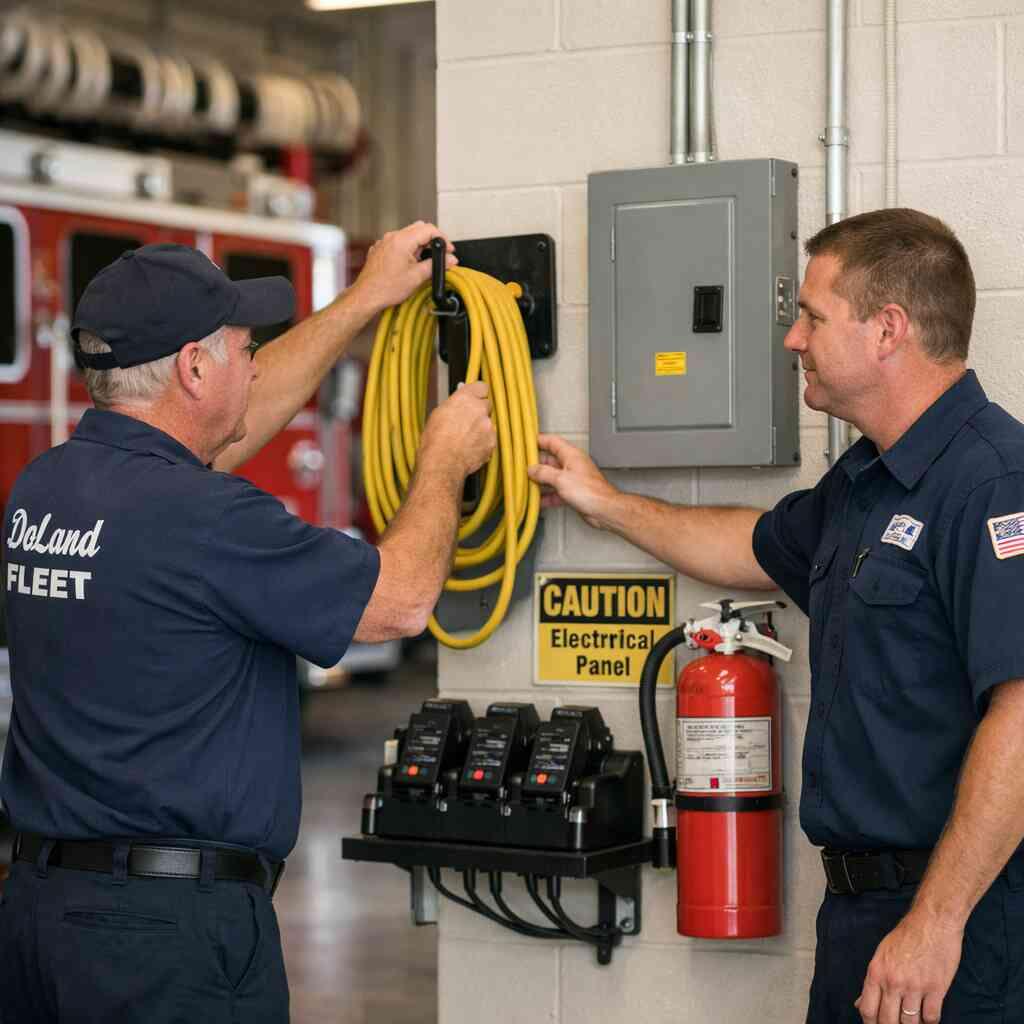
Electrical and charging zones punish small mistakes. A cable left where it should not be, a panel partly blocked, or a charger used without enough clearance can create trouble quickly. These areas deserve a disciplined eye because they are active, energized, and crowded. If your team is repairing apparatus, charging batteries, and moving tools in the same footprint, you need a layout that respects each function. That is where electrical panel clearance requirements in apparatus bays become more than a code phrase.
How electrical panel clearance requirements affect daily access around apparatus and service equipment
Panel access should never depend on moving three things first. If it does, the clearance is wrong. Electrical panel clearance requirements exist so workers can reach disconnects and controls without delay or obstruction. In a busy bay, that means no carts, hoses, staged parts, or opened cabinets crowding the approach. The panel may not be the star of the room, but it must remain visible and usable.
This is also where daily discipline matters most. A bay that stays clear on inspection day but not on ordinary Tuesdays is not truly compliant. It is staged. The better habit is to design the space so clutter has nowhere natural to settle. Clear access should feel boring. Boring is excellent here.
What battery charging area safety really means when cords, chargers, and ventilation all share the same wall
Battery charging areas often become a tangle because everybody assumes the equipment is self-managing. It is not. Battery charging area safety means the chargers are placed correctly, cords are managed cleanly, ventilation supports the environment, and combustible storage stays out of the zone. If all of those things share one wall, you need a serious layout review.
A charging area should also be easy to inspect at a glance. You should see whether a cord is damaged, whether airflow is adequate, and whether any material has migrated too close. One shop we visited had chargers mounted perfectly but stored spare parts directly beneath them. That arrangement looked efficient until you imagined a fault, a leak, or a dropped tool. Efficiency should never outrun safety. If it does, the bay is borrowing trouble.
How lockout tagout procedures should intersect with active repair lanes and energized equipment
Lockout and active work cannot blur together. They need a bright line. Lockout tagout procedures for fleet repair lanes should control who can touch equipment, who can energize it, and how work is released back into service. If a lane includes live equipment nearby, the boundary must be unmistakable. That usually means physical separation, clear tags, and verified communication.
The hardest part is not the paperwork. It is keeping the procedure alive during a busy day. Technicians under pressure may want to shortcut steps. Supervisors should not let them. A good bay makes the safe path the easy path. That is how procedures survive real work instead of fading into binder language.
Why hose and cord management is one of the fastest ways to expose hidden electrical and trip hazards
Hoses and cords reveal hidden disorder fast. They snake across lanes, snag carts, and disguise themselves under low light. Good hose and cord management for OSHA inspections keeps traffic lanes obvious and electrical access easier. It also reduces the chance that a worker will yank a connection loose while moving through a tight space.
Here is the part almost no online guide mentions. Bad cable control often predicts bigger maintenance neglect. If cords are unmanaged, battery leads may also be stressed, labels may be missing, and temporary fixes may be stacking up. That pattern is hard to ignore once you start looking for it. In a serious inspection, the floor tells you what the wall hides.
-
The air, lights, and traffic paths that separate a controlled bay from a chaotic one
Air, light, and traffic work together. If one fails, the others suffer. A bay can have excellent tools and still feel unsafe if diesel exhaust lingers, shadows hide hazards, or vehicles and pedestrians share the same lane without a plan. In active service environments, order is a control system, not decoration. That is why bay ventilation safety controls for diesel exhaust reduction belong in the same conversation as lighting and route planning.
How bay ventilation safety controls support diesel exhaust control measures during busy turnover periods
Ventilation matters most during turnover. That is when engines come and go, doors open and close, and exhaust loads change fast. Bay ventilation safety controls should move air predictably, support diesel exhaust control measures, and reduce the lingering haze that comes after apparatus idles indoors. If the bay smells like exhaust long after movement stops, the control system deserves review.
Good airflow also helps workers think clearly. Heat, fumes, and fatigue combine faster than many managers realize. That is especially true in Florida, where the ambient load is already high. A bay that breathes well feels different. It is easier to work in, easier to inspect, and easier to trust.
What bay lighting adequacy should reveal during an OSHA workplace safety audit
Lighting is not about brightness alone. It is about seeing the right details. During an OSHA workplace safety audit, bay lighting adequacy should reveal floor edges, labels, gauges, and hazards without forcing workers to lean, squint, or use flashlights. Dark corners hide leaks. Glare hides cracks. Poor placement hides both.
A practical way to test lighting is simple. Stand where a technician stands, not where the fixtures hang. Look at work surfaces, not just the ceiling. If shadows cut across controls or create blind spots near lifts and storage, the lighting layout needs adjustment. Good lighting supports accuracy before it supports comfort.
How forklift and apparatus traffic separation should be mapped before the next inspection cycle
Traffic separation should be drawn before people memorize bad habits. Forklifts, service vehicles, and apparatus need distinct paths whenever possible. Fire engine and emergency service bay traffic separation is not just a planning concept; it is the difference between controlled movement and near misses. If a driver cannot predict where pedestrians will stand, the route is incomplete.
Use paint, barriers, and habit reinforcement together. One without the others fades fast. In a busy fleet environment, people default to the shortest route unless the safer route is obvious and convenient. The safest bay makes crossing points rare and intentional. That protects both the machine and the person.
Why emergency exit route clearance and overhead door safety inspection belong in the same pass
These two checks are linked. If an exit route is blocked, the door is more than a door. It becomes part of the problem. Emergency exit route clearance should be verified with the same attention as overhead door safety inspection, because both affect escape and movement. A door that opens correctly still fails if the path below it is crowded.
This is one of those areas where a quick visual scan is not enough. Check the route at worker height, not just from a standing overview. Look for hanging items, parked carts, and equipment stored too close to the path. The best exit route is the one nobody has to think about during an emergency.
-
The inspection trail that keeps DeLand fleet bays ready after the checklist is done
The checklist is not the finish line. It is the proof trail. A bay stays ready when the team can show what was checked, what was fixed, and what is still in process. That is why records, labels, PPE, and equipment organization matter as much as floor condition. Good inspection documentation best practices for municipal fleet facilities make the whole operation easier to defend.
Which inspection documentation best practices make municipal fleet facility compliance easier to defend
Documentation should be clear enough for someone else to follow. Dates, corrections, initials, and locations should all be legible and consistent. If a note says a problem was corrected, the follow-up should show how and by whom. That is the heart of DeLand fleet bay compliance checklist for municipal shops. Good records reduce confusion, and confusion is expensive.
Keep the format simple. If your team cannot complete the form quickly, they will delay it. If they delay it, they will forget details. The best system fits the actual workload and still leaves a reliable trail. That is what makes municipal compliance easier to defend during review.
How hazard communication program details should match chemical storage labeling compliance on the floor
Labels and storage rules must tell the same story. If the paperwork says one thing and the shelf says another, you have a gap. A strong hazard communication program for chemical storage labeling should match what people see in the bay, including container names, hazard warnings, and segregation by use. That consistency matters because workers rely on visual information under pressure.
Chemical storage should also be boringly obvious. No mystery bottles. No unlabeled spray containers. No mixed products sitting in the wrong zone. If someone has to guess, the system already failed. Clear labeling protects the team and speeds compliance work.
What PPE inspection requirements and fire extinguisher accessibility checks should be verified every shift
PPE and extinguishers should be checked often because people use them often. PPE inspection requirements include wear, damage, fit, and availability. If gloves are torn, face shields are scratched, or hearing protection is missing, the system is leaking. The same logic applies to fire extinguisher accessibility checks for fleet facilities. Visibility, access, and signage all matter.
A quick shift change review works well here. Confirm the PPE stations are stocked. Confirm extinguishers are mounted, visible, and not blocked by carts or inventory. Confirm nobody has used the extinguisher area as storage. Small discipline here prevents big problems later.
Where durable equipment for demanding environments fits into a long-term preventative maintenance bay organization plan
Durability matters because bays are hard on gear. Carts scrape. Moisture lingers. Hose-downs happen. That is why durable equipment for demanding environments belongs in your preventative maintenance bay organization plan, especially where repeated use and cleaning are part of daily life. Equipment that holds up in demanding conditions supports consistency.
Fire Power Products fits that mindset well because the brand is built around durable fire safety equipment made for hard use. That does not replace compliance work. It supports it. When your storage, staging, and handling tools are built to endure the bay, your organization plan has a better chance of staying intact. Start today with one walkthrough, one correction list, and one area reset before the next truck rolls out. You do not have to solve every bay problem at once, and you do not have to do it alone.
Frequently Asked Questions
Question: How can Fire Power Products support OSHA ready fleet bay inspection steps for DeLand bays that need better vehicle bay housekeeping standards and slip trip and fall prevention?
Answer: Fire Power Products supports a safer, more organized bay by helping teams build a cleaner preventative maintenance bay organization plan around the realities of heavy-duty fleet bay workflow. For DeLand fleet bay compliance, that usually means keeping walk paths clear, maintaining predictable tool storage and rack safety, and reducing clutter that can affect first responder equipment staging. Durable equipment for demanding environments matters here because bays are exposed to high use, moisture, and frequent washdowns, so the storage and staging tools need to hold up without becoming part of the problem. While the right layout and housekeeping discipline are still the foundation, dependable equipment can make it easier to keep lanes clear, support slip trip and fall prevention, and maintain fire apparatus inspection readiness over time.
Question: What should a DeLand fleet bay compliance review include for spill containment for fleet bays, floor drain maintenance compliance, and anti-slip flooring conditions?
Answer: A practical compliance review should start with the floor, the drains, and the cleanup process. Spill containment for fleet bays should account for the kinds of fluids actually present, whether that is diesel, oil, or hydraulic fluid, and it should also consider how hose-down crews move water through the bay. Floor drain maintenance compliance is important because slow or blocked drains can leave standing water in traffic lanes and create avoidable slip hazards. Anti-slip flooring conditions should be checked under real workflow, not just when the bay is dry and empty. Fire Power Products fits into this picture by offering durable fire safety equipment built for hard use in demanding environments, which helps support a more consistent bay organization plan. That said, no product replaces regular inspection, housekeeping, and prompt correction of hazards. The safest bays are the ones where the layout, the cleanup routine, and the equipment all work together.
Question: How do bay ventilation safety controls, diesel exhaust control measures, and bay lighting adequacy affect fire apparatus inspection readiness during busy shifts?
Answer: These three items shape whether a bay feels controlled or chaotic. Bay ventilation safety controls help move air during busy turnover periods, which supports diesel exhaust control measures and improves working conditions for technicians. Bay lighting adequacy is equally important because poor light can hide floor hazards, labels, leaks, and obstructions that would otherwise be easy to spot. When a fleet bay is preparing for fire apparatus inspection readiness, these systems need to work together so workers can move safely, see clearly, and complete tasks without improvising. Fire Power Products does not replace ventilation or lighting systems, but its durable equipment for demanding environments can support an organized workspace that stays easier to inspect and maintain. That is especially valuable in DeLand, where humidity and frequent activity can make small issues show up quickly.
Question: What do Fire Power Products customers in municipal fleet facility compliance usually ask about electrical panel clearance requirements, battery charging area safety, and hose and cord management?
Answer: The most common concern is whether the bay layout makes safe access obvious or difficult. Electrical panel clearance requirements should never depend on moving carts, parts, or hoses out of the way first. Battery charging area safety should include proper placement, clear airflow, and no stored materials crowding the zone. Hose and cord management is often the quickest indicator of whether a bay has strong day-to-day discipline, because unmanaged cords can create trip hazards and block access to important equipment. In a municipal fleet facility compliance setting, Fire Power Products can support the organization side of that effort with durable equipment that stands up to repeated handling and cleaning. The goal is not just to make the bay look orderly for one inspection, but to help maintain a consistent setup that supports ongoing OSHA workplace safety audit readiness.
Question: In the blog Top 5 OSHA Ready Inspection Steps for DeLand Fleet Bays 2026, what role does inspection documentation best practices play alongside PPE inspection requirements and fire extinguisher accessibility checks?
Answer: Inspection documentation best practices are what turn a checklist into a defensible process. If a bay has good notes, clear dates, and documented corrections, it is much easier to show that PPE inspection requirements are being met and that fire extinguisher accessibility checks are completed regularly. Records should show not only that the items were reviewed, but also what was corrected and when. That matters in DeLand fleet bay compliance because auditors and managers need a reliable trail, not just verbal assurances. Fire Power Products supports that broader readiness mindset by supplying durable fire safety equipment made for demanding conditions, which can help teams keep staging, storage, and access points more organized. Reliable equipment, paired with strong documentation, helps reinforce municipal fleet facility compliance and makes the whole inspection trail easier to maintain.