Top 5 DeLand Fire Truck Wiring Checks for Summer 2026
August 26, 2026
-
The battery connection check that keeps a DeLand rig from dying at the worst possible moment
A dead rig never feels convenient. It usually shows up when the bay is hot, the crew is moving fast, and the call has already started. If you are reading this because a truck cranked slowly, take a breath. That frustration is common, and it usually starts with something small. In DeLand, summer heat and vibration can turn a weak connection into a real failure fast, especially during summer apparatus readiness checks.
Why heat and vibration expose weak battery cable condition faster in summer apparatus readiness
Heat expands metal. Vibration loosens it. Together, they punish battery cable condition assessment work that was already borderline. A cable can look fine from five feet away and still fail under load. That is why DeLand fire truck wiring checks should start with the battery, not the dashboard excuses.
On one recent apparatus walk-through, the problem was not the battery itself. The lug had a slight twist, and the insulation near the tray showed chafing where it rubbed a metal edge. That truck started eventually, but barely. Here is the part most crews miss: a weak connection often behaves like a bad battery until you load it hard. Then the truth shows up.
How to spot loose terminal connection inspection problems before they turn into cranking failure
A proper loose terminal connection inspection begins with touch, sight, and a controlled tug. You want to feel for movement at the post, the lug, and the cable jacket. Look for white or green corrosion, dark heat marks, and swollen insulation. Those are clues, not decoration. They tell you the connection has been working too hard.
Slow cranking, intermittent power, and a click with no start often point to resistance at the terminal. That resistance steals current before the starter ever sees it. In a fire apparatus, that can mean a delayed response when every second matters. A careful fire truck battery connection check catches those symptoms early. It also keeps you from replacing parts that were never the real problem.
What a careful fire truck battery connection check should verify at the tray, lugs, and protective routing
Start at the tray. Check that the battery is secure, the hold-down is intact, and the case is not swollen or cracked. Next, inspect the lugs for clean contact and proper tightening. Then follow the cable path. If the routing lets the cable rub, flex, or sit too close to heat, the repair is not finished.
A good checklist helps. Use this simple one during chassis electrical system check routines:
- Battery secure in tray
- Terminals tight and clean
- Cable lugs undamaged
- Routing protected from abrasion
- Heat exposure minimized
- No pinched or stretched sections
That kind of discipline supports emergency vehicle wiring safety far better than a quick glance ever will.
Where corrosion prevention for fire trucks starts when humidity and road spray keep attacking the chassis electrical system
Corrosion does not need drama. It only needs time, moisture, and metal. In Florida, humidity works on the truck even when it is parked. Road spray adds another layer of trouble. That is why corrosion prevention for fire trucks starts at the smallest exposed surfaces, not just the obvious battery posts.
We usually see the first trouble at unsealed edges, scratched lugs, and fasteners that have lost their protective coating. The fix is not just cleaning. It is protecting the area so moisture cannot return quickly. If you want better fire truck electrical reliability, treat corrosion as a system problem, not a one-time cleanup.
-
The alternator output inspection that decides whether your electrical load is actually sustainable
If the battery is the reserve tank, the alternator is the engine that keeps the reserve full. That matters more in summer, when lights, radios, climate systems, and scene gear all pull at once. Many crews feel the first clue in weak voltage at idle, but they do not always trace it correctly. That is where a steady alternator output inspection saves time, money, and stress.
How to tell if the alternator is truly carrying the scene lights, radios, and warning system wiring demand
An alternator can pass a basic test and still fail under real demand. The question is not only whether it charges. The question is whether it keeps up when the truck is loaded. Scene lights, warning bars, radios, and auxiliary gear all demand current. That is where warning system wiring and charging capacity must work together.
Watch voltage under load, not just at idle. If the system dips when multiple accessories run, you may be seeing an output problem. That does not always mean the alternator is bad. Sometimes the issue sits in the wiring path or the connections that carry the current. A thoughtful alternator output inspection separates those possibilities.
What charging irregularities can reveal about hidden heat-related wiring issues in the fire apparatus wiring harness
Charging problems often hide in plain sight. A flicker, a brief voltage drop, or a warm connector can point to heat-related wiring issues inside the harness. Heat raises resistance. Resistance creates drag. Drag creates inconsistency. That pattern matters because inconsistent charging is often a wiring story before it becomes a parts story.
On the projects we have seen this year, the most frustrating failures were not dramatic. They were intermittent. A truck would charge well on one run and act tired on the next. That is exactly why fire apparatus wiring harness checks belong beside the alternator itself. The harness can be the weak link even when the alternator tests within range.
Why a steady alternator output inspection matters more when summer use pushes emergency vehicle wiring safety to the edge
Summer use exposes margin. Winter may let a weak system hide. Summer does not. A truck that can barely support its load in a controlled bay may struggle badly on a hot street scene. That is why emergency vehicle wiring safety depends on more than peak performance. It depends on consistency.
If you are comparing load patterns, it helps to think in simple terms:
SymptomLikely concernWhat to inspect nextVoltage drops with accessoriesOutput strainAlternator and cablingBattery drains after short runsCharging path issueConnections and harnessHot connector near output lineResistanceTerminals and routingThat table can keep you from guessing. It also speeds up fleet maintenance for fire departments by narrowing the search early.
Which warning signs suggest the problem is in the charging path rather than the battery itself
Here is the part many people miss: a battery that tests weak may be innocent. If the charging path is poor, the battery only reflects the damage. Watch for slow recovery after startup, flickering lights, and hot spots near connectors. Also listen for a whining alternator or irregular gauge behavior. Those clues point you toward the path, not just the battery.
A truck in Deltona once came in with repeated “bad battery” complaints. The battery passed after charging. The real issue was a loose connection at a charging lead that heated under load. One small fix solved a big headache. That is why deeper fire apparatus diagnostics can matter more than part-swapping.
-
The harness walkdown that finds wire insulation damage before moisture intrusion does
A harness walkdown feels tedious until it saves a truck. Then it feels obvious. You are looking for the early signs of trouble before summer storms, washdowns, and daily vibration push minor damage into major failure. This is one of the most practical parts of preventive maintenance for fire apparatus.
Where abrasion and vibration damage in fire apparatus usually show up first along the fire apparatus wiring harness
Start where the harness moves. Look near clamps, hinges, frame crossings, and any place the bundle bends sharply. Those spots collect vibration damage in fire apparatus faster than straight runs do. Insulation usually tells the story first. You may see flattening, polishing, or tiny nicks before a true break appears.
The best inspections use slow, deliberate movement. Gently shift the harness and watch for rubbing points. Inspect against metal edges, brackets, and zip ties that are too tight. The goal is to catch wire insulation damage before it opens a path for moisture. Once water gets in, the repair becomes more complex.
How connector seal inspection helps stop moisture intrusion in electrical systems after washdowns and summer storms
Washdowns are necessary. So are summer storms. But both can expose weak seals. A careful connector seal inspection checks for cracked boots, loose couplers, and flattened gaskets. If a seal no longer closes properly, moisture intrusion can follow quickly. That can lead to corrosion, intermittent faults, or dead circuits.
One crew told us their issue only appeared after a heavy rinse and an afternoon storm. The warning light stayed on longer than it should, then reset itself. The connector looked clean from the outside. Inside, though, water had reached the contact surface. That is why moisture intrusion in electrical systems is so deceptive. It often waits until the truck is back in service.
What to look for when wire insulation damage is hiding under clamps, bends, and high-movement points
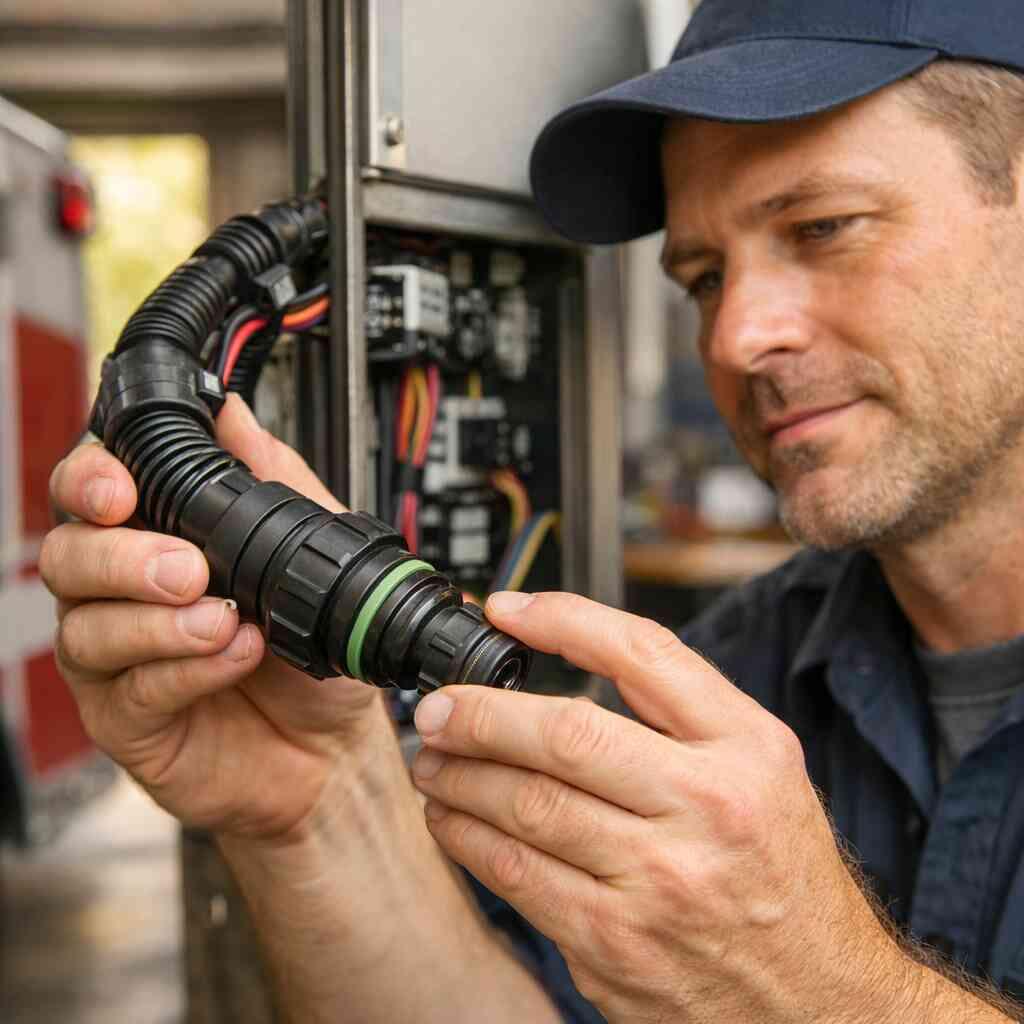
Some damage hides where your eyes naturally skip. Check under clamps. Check behind panels. Check at every bend that flexes with motion. If the insulation looks shiny, brittle, or compressed, treat it as suspect. Also inspect for heat discoloration near components that run warm. A thorough fire apparatus wiring harness review should include both visible and hidden sections. Small damage at one point can spread when the truck moves and vibrates. For deeper protection, products designed for rugged connectors can help reduce failure points. If you are comparing connector options, fire apparatus wiring harness checks for emergency vehicle safety deserve a closer look before you choose a fix. ### Why corrosion prevention for fire trucks must include the smallest terminals not just the obvious power feeds
Big cables get attention. Small terminals fail quietly. That is a dangerous combination. Tiny contact points can corrode, loosen, and interrupt a whole circuit. You may not notice until a switch behaves strangely or a light quits under load. That is why corrosion prevention for fire trucks must include every terminal, not just the main feeds.
In practice, that means checking weather-exposed plugs, accessory connectors, and hidden pigtails with the same care you give the battery posts. If a connector is repeatedly exposed to water or dust, the seal quality matters. Fire Power’s rugged connector categories are built around that idea, and IP68 female electrical connector pigtails for fire truck wiring are one example worth evaluating when your maintenance plan needs more durability.
-
The relay and protection review that keeps one bad circuit from taking down the whole truck
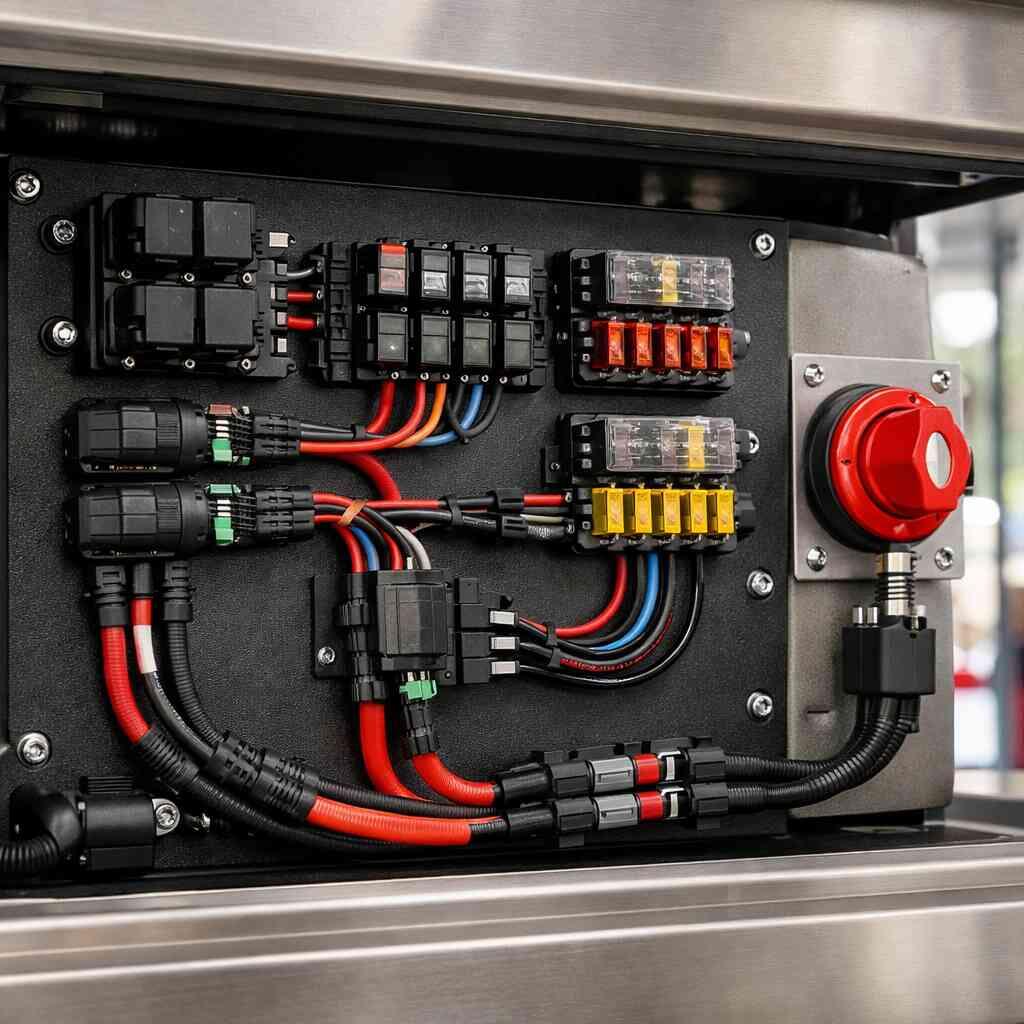
Electrical failures love chain reactions. One weak relay, one tired breaker, or one poor ground can turn a simple issue into a truck-wide headache. That is why relay and protection work deserves respect during fire truck electrical inspection routines. It is not glamorous. It is essential.
How a fuse and circuit breaker review can isolate a failing circuit before it cascades into downtime
A fuse and circuit breaker review should not be random. Start with the circuits that matter most during response: lights, comms, warning systems, and control functions. If a breaker is tripping repeatedly, do not simply reset it and move on. Find out why it is seeing overload or resistance.
The goal is containment. A single bad branch should not stall the whole apparatus. Check the protective device rating, the load, and the condition of the circuit it serves. That approach reduces downtime and keeps you from missing a deeper fault. A disciplined review also makes lighting circuit troubleshooting far faster later.
What a relay panel inspection should uncover in fire truck electrical inspection routines
Relays age. Contacts pit. Heat changes how they behave. A solid relay panel inspection looks for discoloration, corrosion, loose seating, and inconsistent operation. If a relay chatters or sticks, the load may not be the real problem. The control side may be failing first.
This is where experienced eyes help. A relay that sounds normal can still be unreliable under heat. If the panel has multiple layers of accessories, trace each one carefully. That is especially important when you are trying to preserve fire truck electrical reliability during a heavy-use season. Small relay failures can become large operational headaches.
Why grounding problems and ground fault detection in fire trucks become harder to ignore in hot weather
Hot weather changes behavior. Resistance rises. Marginal grounds get worse. That is why ground fault detection in fire trucks matters more when temperatures climb. A weak ground may only show up under specific load conditions, which makes it maddening to diagnose. Still, the pattern usually exists.
Look for dim lights, odd sensor readings, and erratic accessory operation. Those symptoms often point to a ground path that is no longer clean or secure. Here is a practical rule: if multiple circuits act strangely at once, think grounding before blaming each component individually. A well-run chassis electrical system check can confirm that quickly.
How to approach lighting circuit troubleshooting without chasing the wrong component for hours
Do not chase symptoms blindly. Start at the power source, then move through the relay, protection device, connector, and load. That sequence cuts wasted time. It also keeps you from replacing a good light module when the real issue is upstream. A careful map of the circuit beats guesswork every time.
If the problem seems to jump between components, compare them side by side. Also check terminal tension and connector integrity. For tougher inspections, some shops use more robust accessory hardware as part of the solution set. junction receptacles and accessories for fire apparatus electrical inspection can be a practical place to start when you need durable connection points that support long-term service.
-
The final readiness pass that separates a dependable apparatus from a risky one
The last pass is where you catch what the earlier checks missed. It is also where you prove the truck is ready, not merely repaired. A dependable apparatus does not just start. It performs consistently under the exact conditions it will face on the street. That is the point of a true summer apparatus readiness review.
What an emergency lighting functionality check should prove before the truck rolls out for summer calls
An emergency lighting functionality check should verify more than “on” and “off.” You want proper brightness, correct flashing patterns, full coverage, and reliable activation from each control point. If one light lags or flickers, that is not cosmetic. It may signal wiring resistance or a control issue.
Use a systematic walk-around. Check front, sides, rear, and auxiliary lights. Then verify the truck responds the same way from every relevant switch. If you are trying to reduce surprises on call night, this is where you do it. A few extra minutes here can prevent a return-to-station problem later.
Why pump panel wiring inspection and scene light electrical check deserve the same attention as drivetrain service
People naturally focus on engines, tires, and brakes. They should. But pump panel wiring inspection matters just as much when a truck depends on electrical controls at the scene. The same goes for a scene light electrical check, especially when the station depends on that gear for visibility and safe operations.
If a pump panel display glitches or a scene light falters, the issue may not seem urgent until the next call. Then it becomes urgent fast. That is why the electrical side deserves equal respect in summer fire apparatus maintenance. The apparatus has to support the work, not complicate it.
How siren and warning system wiring can reveal broader issues in the chassis electrical system check
Siren behavior is a useful clue. If the tone cuts out, changes unexpectedly, or triggers other faults, the problem may be deeper than the siren itself. Siren and warning system wiring often shares pathways with other critical circuits. When one part goes unstable, it can reveal a broader pattern in the system.
That is one reason chassis electrical system check work should end with a live-function review. Push the controls. Watch the response. Listen for inconsistencies. A truck that sounds slightly off may be telling you exactly where the hidden issue lives.
When to escalate from routine preventive maintenance for fire apparatus to a deeper fire apparatus diagnostics plan with DeLand emergency vehicle service
Routine maintenance has limits. If you keep seeing repeated faults, unexplained voltage changes, or intermittent failures after repairs, it is time to go deeper. That is the point where fire apparatus diagnostics becomes the smarter move. The goal is not just to patch symptoms. It is to find the pattern.
If your truck keeps circling the same electrical complaint, do not wait for a worse breakdown. Bring in a structured inspection, compare the data, and document what changes under load. For teams that want the right parts and support, start with DeLand fire truck wiring inspections for summer 2026 and use that as your maintenance benchmark. You do not have to solve every electrical problem alone. Start with one careful inspection, one honest diagnosis, and one plan that keeps the rig ready for the next call.
Frequently Asked Questions
Question: What should DeLand crews prioritize first during a fire truck battery connection check in summer fire apparatus maintenance?
Answer: Start with the battery tray, terminal tightness, cable routing, and visible signs of corrosion or chafing. In DeLand, Florida, heat and vibration can turn a small loose terminal connection inspection issue into a cranking failure fast. A good fire truck battery connection check should confirm the battery is secured, the lugs are clean and tight, the cable jacket is not rubbing on metal, and there is no swelling, cracking, or heat damage. That kind of battery cable condition assessment supports emergency vehicle wiring safety and helps prevent avoidable downtime. Fire Power Products focuses on durable fire safety equipment designed for demanding use, so it is a practical place to start when crews want to improve fire truck electrical reliability and keep high-temperature equipment readiness on track.
Question: How does an alternator output inspection help identify heat-related wiring issues in the fire apparatus wiring harness?
Answer: An alternator output inspection should not stop at whether the unit charges at idle. It needs to show whether the system can carry real electrical demand from lights, radios, warning equipment, and other accessories during summer apparatus readiness checks. If voltage drops under load or a connector feels hot, the issue may be in the charging path, not just the alternator itself. Heat-related wiring issues and resistance inside the fire apparatus wiring harness can create intermittent charging problems that look like a battery failure at first. By checking the alternator, cabling, and harness together, crews can support apparatus downtime prevention and make better decisions during DeLand emergency vehicle service or fleet maintenance for fire departments.
Question: In Top 5 DeLand Fire Truck Wiring Checks for Summer 2026, what wiring areas are most likely to show vibration damage in fire apparatus before moisture intrusion becomes a problem?
Answer: The most common trouble spots are harness sections that move, bend, or touch hard edges. That includes frame crossings, hinge points, clamp locations, and any area where the fire apparatus wiring harness flexes with vehicle motion. Over time, vibration damage in fire apparatus can wear through insulation and create wire insulation damage that later allows moisture intrusion in electrical systems. A careful connector seal inspection is also important after washdowns or summer storms, because even a small seal failure can let water reach the contacts. Fire Power Products is a strong fit for crews that want heavy-duty wiring durability and first responder equipment upkeep support, especially when the goal is to reduce corrosion prevention for fire trucks issues before they become failures.
Question: Why are fuse and circuit breaker review and relay panel inspection so important during a fire truck electrical inspection?
Answer: Fuse and circuit breaker review and relay panel inspection help isolate problems before they spread through the entire truck. A breaker that trips repeatedly may be signaling overload, resistance, or a failing circuit rather than a simple nuisance. Likewise, a relay panel inspection can uncover pitted contacts, loose seating, heat damage, or intermittent control failures that affect lighting, sirens, pumps, or warning systems. When combined with lighting circuit troubleshooting and ground fault detection in fire trucks, these checks give crews a clearer picture of system health. That is especially important for NFPA-aligned maintenance practices and for reducing apparatus downtime when summer fire apparatus maintenance demands are highest.
Question: How can Fire Power Products help support emergency lighting functionality check, pump panel wiring inspection, and scene light electrical check routines?
Answer: Fire Power Products is built around rugged fire safety equipment designed for demanding conditions, which makes it a practical resource when departments are reviewing electrical connection points and accessory hardware during emergency lighting functionality check routines. For crews doing pump panel wiring inspection or scene light electrical check work, durable connectors and well-protected routing points can help support fire truck electrical reliability over time. While every apparatus should be inspected based on its own configuration and maintenance plan, choosing components intended for harsh service can make routine inspections easier and more consistent. That matters for emergency response vehicle inspection work, high-temperature equipment readiness, and reliable siren and warning system wiring performance during busy summer call volume.
Question: When should a department move from preventive maintenance for fire apparatus to deeper fire apparatus diagnostics in DeLand?
Answer: If the same electrical problem keeps returning, or if a truck shows intermittent failures, unexplained voltage changes, repeated warning light issues, or inconsistent starting behavior after repairs, it is time to move beyond routine preventive maintenance for fire apparatus. At that stage, deeper fire apparatus diagnostics can help identify whether the root cause is in the battery cable condition assessment, the charging path, the chassis electrical system check, or hidden corrosion prevention for fire trucks concerns. That approach is especially valuable for fleet maintenance for fire departments and emergency response vehicle inspection planning. Fire Power Products can be part of that process by supporting equipment choices that align with durable, first responder equipment upkeep needs in DeLand, Florida, without relying on unverified claims about performance or certification.