Top 5 UL 2026 Inspection Tips for DeLand EMS Buyers
June 25, 2026
If you are reading this at 11 p.m. because an inspection note just landed on your desk, take a breath. That knot in your stomach is normal. UL inspection tips are not difficult because the logic is hidden. They are difficult because the paperwork, the install, and the vehicle itself do not always tell the same story. For DeLand EMS buyers, that gap can slow procurement, delay readiness, and create avoidable headaches during an EMS equipment inspection and compliance verification in DeLand Florida.
What we see most often is simple. A department buys with urgency, installs with good intentions, and then discovers the documentation trail is thin. The fix is not panic. The fix is discipline. If you approach the next purchase like a compliance verification process, you protect both the fleet and the people who depend on it.
-
Verify the UL file and label trail before anything else
The first inspection mistake is rarely mechanical. It is usually documentary. If the product marking, file number, or label trail does not line up, the review can stall before anyone even touches a wrench. That is why UL compliance considerations matter early, not late. You want the paperwork to tell the same story as the apparatus.
A good starting point is the label itself. Match the product marking to the paperwork so the inspection does not stall on a missing UL compliance breadcrumb. Then compare the invoice, the install sheet, and the current unit configuration. If those three documents disagree, the inspector will notice. So will your maintenance team.
One fleet manager in central Florida described a frustrating morning where a unit passed visual review but failed on documentation. The part was installed correctly. The file trail was not. The result was a simple correction that still cost a full afternoon. That is the part most buyers miss. The hardware was fine. The recordkeeping was not.
Match the product marking to the paperwork so the inspection does not stall on a missing UL compliance breadcrumb
Start with the label on the installed component. Then pull the purchase records and compare every identifier. Look for the exact model designation, connector family, and any included accessory package. If a part is documented generically, that may not be enough for a formal review. Precision matters here.
For DeLand EMS buyers, this is especially important when multiple vendors or replacement cycles have touched the same apparatus. A unit may carry newer accessories than the original spec sheet suggests. That is not automatically a problem. It becomes a problem when the current installation is not traceable. Keep your UL inspection tips for DeLand EMS buyers in 2026 tied to the actual equipment on the rig, not a memory of what was ordered months ago.
Check that the exact model, connector style, and accessory package on the invoice align with what is installed on the apparatus
This is where inspection-ready gear either helps or complicates your day. The invoice should identify the same connector style you can see on the vehicle. If you ordered one configuration and received another, even a small mismatch can create questions during an apparatus readiness audit. You do not want the inspector guessing.
We recommend comparing three things side by side:
- The invoice description
- The installed label or marking
- The physical connector and accessory package
If one of those drifts, stop and investigate. In public safety procurement, that small pause saves future confusion. It also makes replacement planning far easier when the same component needs service again.
Separate current documentation from legacy spec sheets that may look official but no longer describe the equipment in service
Legacy sheets are sneaky. They often look polished, official, and perfectly believable. Still, they may describe an older revision no longer in service. That is why you should treat any archived sheet as reference material, not proof. Here is what almost no online guide mentions: outdated paperwork can survive longer than the gear itself.
On the projects we’ve finished this year, the cleanest approvals came from departments that kept a current file folder for each apparatus. They did not rely on a general binder. They tracked the installed equipment as a living record. That approach helps with fire apparatus inspection, replacement cycles, and long-term equipment longevity planning. It also reduces back-and-forth when a reviewer asks for documentation review support.
-
Treat the environmental abuse test as the real exam
The real exam is not the brochure. It is the bay floor, the rinse-down, the vibration, the heat, and the daily handling. That is why rescue equipment readiness depends on more than a brand claim. You need to ask how the gear behaves after repeated use, not just how it looks on day one. In DeLand, where moisture, heat, and hard service can stack up quickly, that question matters.
Most buyers understand this instinctively. What they do not always see is where failure begins. Water intrusion starts small. A seal flexes, a strain relief loosens, or a termination sees repeated movement. Then the issue appears during a shift you already had too much to do.
We hear this from clients almost every week. They want durable fire safety equipment, but they also want confidence that the gear will stay inspection-ready after actual work. That is a reasonable expectation. It is also the right one.
Look for hose-down resistant equipment behavior in the places where water intrusion usually starts
Do not just ask if a part is “water resistant.” Ask where the water goes first. Inspect the edges, connector interfaces, and low points where spray and runoff collect. Hose-down resistant equipment should show thoughtful sealing, not cosmetic confidence. If the weak point is visible, it is already too late.
This is also where hose-down resistant equipment and IP68 connector durability becomes a practical buying lens, not a marketing phrase. The goal is not to prove immortality. The goal is to reduce avoidable vulnerability during routine washdown and field exposure. That is a realistic standard for emergency response gear checklist planning.
Inspect seals, strain reliefs, and terminations for the kind of wear that shows up after repeated bay use and field deployment
Seals tell a story. So do bent strain reliefs and polished terminations. When those parts show wear, the unit is telling you where movement concentrates. Repeated bay use can create stress that never appears in a static bench test. That is why a visual inspection needs a tactile check too.
Touch the component. Check for looseness. Look for cuts, flattening, and abrasion. Then ask yourself if the part still supports rescue equipment readiness after heavy use and field exposure. If the answer feels uncertain, it probably is. Uncertainty is a maintenance finding, not a personality trait.
Decide whether the gear still fits rescue equipment readiness after exposure to heat, vibration, and routine handling
Heat and vibration are patient enemies. They do not fail equipment dramatically at first. They wear it down. A part can seem fine in the shop and still behave poorly in the field. That is why maintenance best practices for responders should include periodic reevaluation, not just initial install checks.
A small DeLand department once asked us why a recently installed setup felt “loose” after a few months. The issue was not a single broken part. It was cumulative movement at multiple points in the system. Once the team rechecked routing and support, the problem became obvious. That is the lesson: you are not only inspecting a component. You are inspecting a system.
-
Audit connectors and pigtails like an apparatus readiness problem
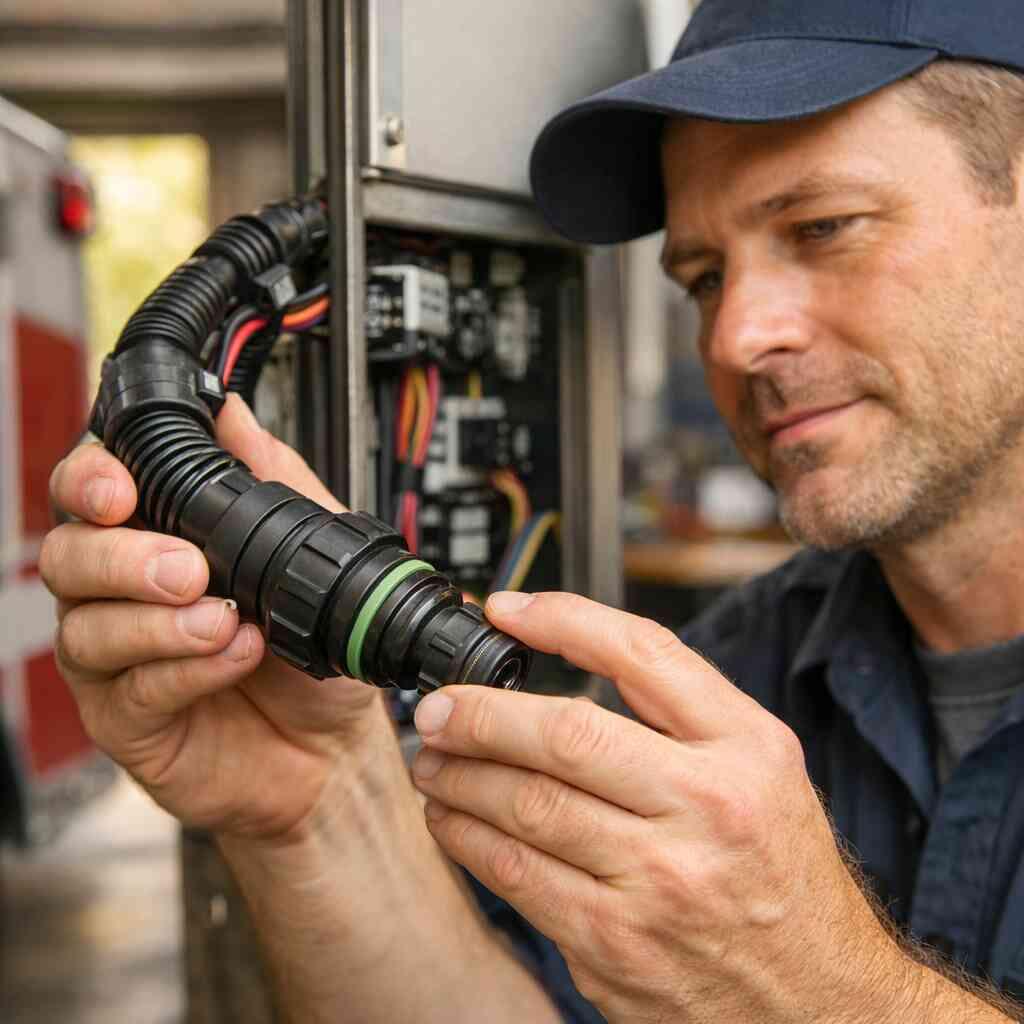
Connectors and pigtails are easy to overlook until they are the reason a unit sits idle. That is why they deserve the same attention you would give a pump control or a critical relay. If the electrical path is weak, the vehicle is weak. It is that plain. For EMS fleet equipment evaluation, these small parts carry outsized responsibility.
The best way to evaluate them is to compare the installed parts against the electrical demands of the vehicle. Not every circuit has the same load, duty cycle, or routing challenge. The wrong connector choice can turn a clean installation into a recurring maintenance task. That is a poor trade.
A fire service equipment buying guide for public safety procurement should always include the connection path. If it does not, you are only buying half the solution.
Compare Fire Power IP68 female electrical connector pigtails and male pigtails against the circuit demands on the vehicle
Start with the load. Then look at the connector family. Then confirm the pigtail configuration matches the installation logic. Fire Power IP68 female electrical connector pigtails and male pigtails should be considered in relation to the vehicle’s actual electrical demands, not a generic parts list. That distinction matters for apparatus readiness.
Here is a simple comparison that helps teams avoid mistakes:
Item to compareWhat to verifyWhy it mattersFemale pigtailConnector match and placementHelps prevent fit issuesMale pigtailCorrect mating and load pathSupports reliable connectionsCircuit demandCurrent and duty needsReduces overload riskAccessory packageInstalled componentsKeeps inspection records cleanIf you want a practical next step, review your emergency response gear checklist against the exact installed connector path. Then match it to the maintenance record. That is how you avoid surprises later.
Confirm that electrical extensions and junctions are not creating weak points in the emergency response gear checklist
Extensions and junctions are not inherently problematic. Poorly considered ones are. Every added connection point creates another place for movement, moisture, or service error. That is why you should ask whether the extension solves a real need or simply adds complexity. Simplicity wins during inspections.
On one recent review, an apparatus had a clean-looking setup that failed because the extension routing made access awkward during inspection. The gear worked. The layout did not support fast review or easy maintenance reset. Once the team corrected the routing, the entire system became easier to service. That is the hidden value of planning ahead.
Flag any mismatched components that could complicate future fire apparatus inspection or slow a maintenance reset
Mismatched components create confusion long before they create failure. A junction from one family, a pigtail from another, and an accessory that does not belong in the current setup can make future service painfully slow. Inspectors and technicians both prefer consistency. So do procurement teams.
This is where Fire Power electrical extensions and junctions for maintenance planning can be useful as part of a deliberate, documented system. But the key word is deliberate. If the parts list does not reflect the actual installation, future fire apparatus inspection becomes harder than it should be. Keep the configuration clean, and future maintenance becomes far more manageable.
-
Read the installation like a compliance verification process
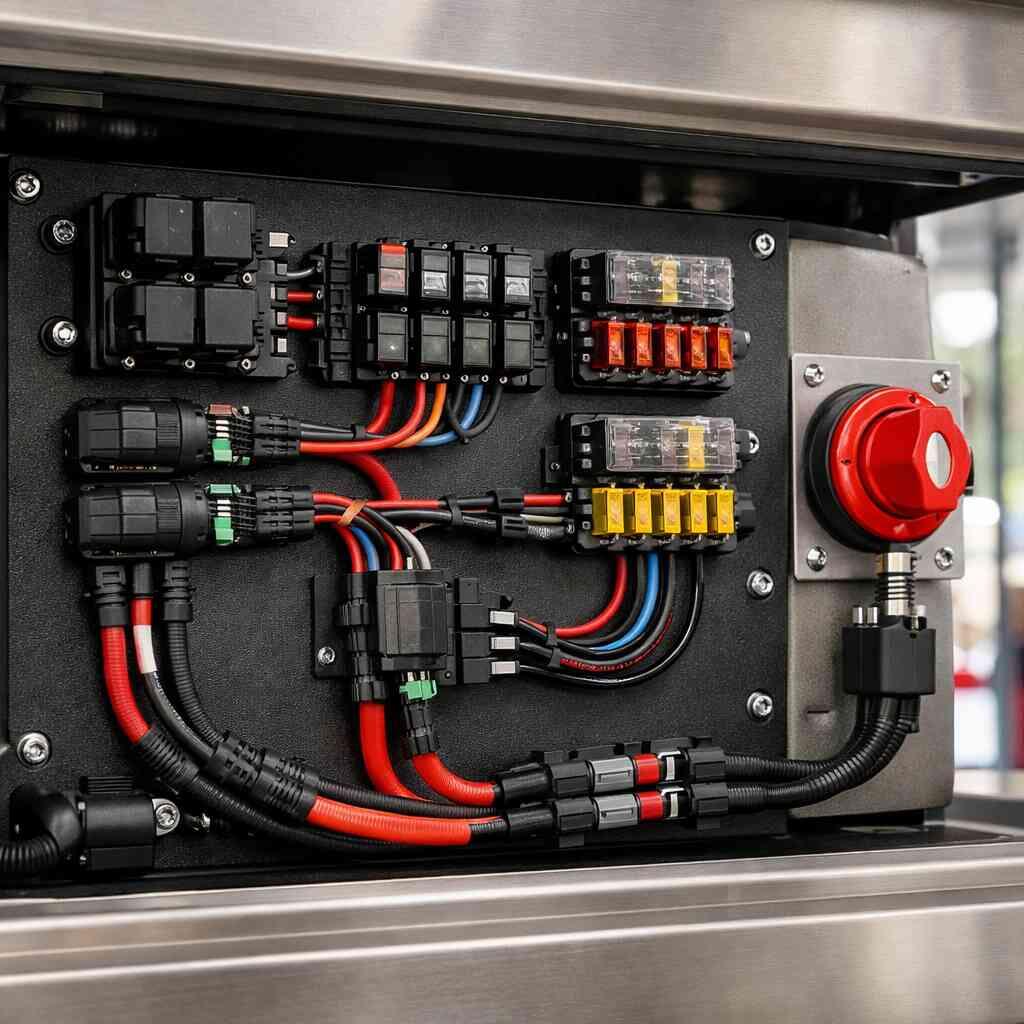
The installation tells the truth when the paperwork is incomplete. That is why you should read every receptacle, junction, and accessory as part of a compliance verification process. A good install does more than function. It supports review, service, and future replacement without forcing anyone to guess. That is the standard you want for inspection documentation review.
This is where routing and access matter. If a component is buried behind hardware or routed in a way that invites damage, the install may look finished while still being fragile. We see this most often on rushed retrofits. The system may work today, but it does not support long-term equipment longevity planning.
DeLand buyers face the same challenge as larger departments, only with less time to spare. That makes documentation and layout even more important. You need clean installs that can survive scrutiny and service intervals alike.
Trace every receptacle, junction, and accessory from the power source to the load so hidden field changes do not get missed
Start at the source and follow the path. Do not assume the current setup matches the original design. Field changes happen constantly, especially when equipment is repaired between calls. A hidden adapter, rerouted lead, or substituted accessory can change how the system behaves.
A careful trace also helps you catch unauthorized improvisation. That matters because improvisation is often invisible in the field and expensive in the shop. For fire apparatus inspection and installation review, traceability is the difference between confident approval and awkward discovery.
Check routing, protection, and access points for signs that the installation may fail an inspection documentation review
Good routing protects the system from abrasion and heat. Good access supports maintenance. Bad routing does the opposite. Inspect the path for pinch points, rubbing surfaces, and locations where a technician would struggle to reach the component. Then ask if the install would still make sense after a year of service.
This is a practical way to think about electrical connector standards for emergency vehicle equipment, but the standard is only useful if the system is installed in a maintainable way. In other words, compliance is not just about what is present. It is about whether the arrangement can be understood and serviced later. That is the part that protects your inspection record.
Use a public safety procurement mindset to decide whether the current setup supports long-term equipment longevity planning
Procurement should not end at purchase approval. It should shape the next five service cycles. Ask whether the current setup supports replacement, troubleshooting, and documentation without drama. If the answer is no, the purchase may still be acceptable, but the install strategy needs work.
This is where public safety procurement becomes more than a budget process. It becomes a readiness strategy. The departments that do this well think in terms of operational reliability for EMS, not just initial cost. They buy once, maintain well, and avoid rework. That is smart stewardship, not overthinking.
-
Build the buying decision around the next inspection not the sales pitch
Sales materials can be useful. They are not the whole story. The better question is simple: will this purchase make the next inspection easier? If the answer is yes, the gear has real value. If the answer is unclear, keep digging. That mindset separates a quick purchase from a sound fleet decision.
The most durable choices support maintenance best practices for responders and reduce friction later. They fit the inspection workflow. They also fit the replacement schedule. That is why inspection-ready gear should be evaluated by serviceability, not just promise. On the Fire Power side, that thinking aligns naturally with durable fire safety products for EMS fleet equipment evaluation. Reliability starts with the buying decision.
The question we get more than any other from first-time EMS buyers is this: “How do I know I am not buying tomorrow’s problem?” The honest answer is that you cannot eliminate all risk. You can, however, reduce it sharply by buying for inspection, service, and traceability from the beginning.
Compare inspection-ready gear options by how easily they support maintenance best practices for responders
The best products are easy to inspect, easy to service, and easy to document. That does not mean simplistic. It means sensible. If a product forces excessive disassembly for routine checks, it adds labor. If it requires unique documentation logic, it adds risk. Both matter.
A practical comparison should include:
- Ease of visual inspection
- Access for replacement or reset
- Clarity of labeling and traceability
- Compatibility with existing apparatus layouts
- Support for maintenance best practices for responders
If one option looks stronger but creates service friction, pause. Inspection-ready gear should reduce complexity, not redistribute it.
Evaluate whether a purchase strengthens emergency vehicle equipment assessment across the full EMS fleet equipment evaluation cycle
Think beyond one vehicle. Think fleet. A purchase that helps one ambulance but complicates the rest can cost more over time. Your emergency vehicle equipment assessment should consider consistency, training, and replacement planning across the entire EMS fleet equipment evaluation cycle.
That is especially important in DeLand Florida fire equipment needs, where weather, call volume, and service expectations can vary. Standardization helps crews move faster and maintain cleaner records. It also makes parts ordering less chaotic. That alone can save real time when a unit needs to return to service quickly.
Turn the final selection into a procurement checklist for EMS departments that prioritizes operational reliability for EMS and trusted fire safety products
Before you approve the purchase, turn it into a checklist. Confirm labeling. Confirm connector family. Confirm service access. Confirm documentation. Confirm that the install supports future inspection without guesswork. Those five checks can prevent a lot of noise later.
If you want a simple next step, review your current stock against one procurement checklist for EMS departments and remove anything that cannot be traced cleanly. Then call contact Duraline for inspection-ready fire equipment support if you need help aligning the hardware with the paperwork. You do not have to figure this out alone, and you do not have to figure it all out today. Start with one phone call, then inspect one unit with fresh eyes.
Frequently Asked Questions
Question: How do DeLand EMS buyers use UL inspection tips to avoid problems during EMS equipment inspection and compliance verification?
Answer: The best approach is to verify the documentation, the installed equipment, and the physical label trail before the inspection starts. For DeLand EMS buyers, that means checking that the invoice, install sheet, and actual apparatus configuration all match. This helps prevent delays during an EMS equipment inspection and supports a cleaner compliance verification process. Fire Power Products is a strong fit for buyers who want inspection-ready gear because the focus is on durable fire safety equipment that can be documented clearly and maintained with less confusion. When the paperwork aligns with the installed equipment, you reduce rework, improve operational reliability for EMS, and make future inspection documentation review much easier.
Question: What should I look for in hose-down resistant equipment and heavy-use equipment durability before purchasing for a fire apparatus inspection?
Answer: Look closely at where wear starts, not just at how the product looks on day one. For fire apparatus inspection planning, that means reviewing seals, strain reliefs, terminations, routing, and any points where water or vibration can create long-term issues. Hose-down resistant equipment should be evaluated for practical resistance to routine washdown and field exposure, while heavy-use equipment durability should be judged by how well the system holds up after repeated handling. Fire Power Products is positioned around those real-world demands, with American-made safety equipment designed for tough conditions and daily use. That matters because inspection-ready gear must support rescue equipment readiness long after the initial install.
Question: In the blog Top 5 UL 2026 Inspection Tips for DeLand EMS Buyers, why is connector and pigtail selection such a big part of public safety procurement?
Answer: Connector and pigtail selection matters because a weak electrical path can create inspection issues, maintenance headaches, and equipment downtime. In public safety procurement, the right connector family, pigtail configuration, and accessory package should match the actual circuit demands on the vehicle. That is especially important when you are building an emergency response gear checklist or planning EMS fleet equipment evaluation. Fire Power Products helps buyers think in terms of the full connection path, not just the visible device. This makes it easier to support apparatus readiness audit requirements, reduce mismatches, and maintain first responder equipment standards across the fleet.
Question: How can Fire Power Products help with inspection documentation review and equipment longevity planning for EMS fleet equipment evaluation?
Answer: A strong purchase supports more than immediate use. It should also make inspection documentation review, replacement planning, and maintenance easier over time. Fire Power Products is a good option for departments that want to build around trusted fire safety products and a practical compliance verification process. The key is consistency: clear labeling, traceable parts, and installations that are easier to understand during future inspections. That supports equipment longevity planning and helps departments avoid guesswork when a component needs servicing or replacement. For EMS fleet equipment evaluation, that kind of clarity can save time, reduce administrative friction, and improve operational reliability for EMS.
Question: What makes Fire Power Products a good choice for a procurement checklist for EMS departments focused on rescue equipment readiness and maintenance best practices for responders?
Answer: Fire Power Products is a smart fit when the procurement checklist for EMS departments prioritizes serviceability, traceability, and durability rather than just upfront price. A well-built purchase should support maintenance best practices for responders, help simplify future inspection-ready gear reviews, and fit cleanly into the existing apparatus layout. That kind of planning is important for rescue equipment readiness because it reduces avoidable service interruptions and keeps the system easier to inspect and maintain. For departments comparing rescue and EMS purchasing decisions, the best option is usually the one that supports the next inspection, the next service interval, and the next deployment without creating extra complexity.