What Is the Best IP68 Seal for Fire Trucks in Summer 2026
August 1, 2026
Why the seal that looked fine in the shop starts failing once a fire truck hits summer heat and washdowns
A seal can look perfect on the bench and still fail on the rig. That is the frustrating part. Summer heat expands materials, and washdowns push water where it should not go. Add vibration, road grit, and constant door cycling, and weak points show up fast.
If you are reading this because a connector, gland, or panel keeps acting up, you are not alone. That knot in your stomach is real. We hear it from crews who need the truck ready every shift, not after a second repair. The hard part is that the failure often starts small and stays hidden.
The best IP68 seal for fire trucks is not just about a label. It is about how the sealing system behaves under heat, spray, dust, and movement. In practice, fire truck waterproof sealing has to survive the way apparatus actually lives, not the way it sits in the shop.
How heat, moisture, vibration, and road grit team up to attack fire apparatus electrical points
Heat softens some materials. Moisture finds tiny gaps. Vibration keeps widening those gaps. Road grit then acts like sandpaper inside the connection. That combination is why vibration-resistant seal design matters so much on apparatus.
One crew told us about a compartment light that kept flickering after long calls. The connector looked clean. The issue was not the visible face of the seal. It was the repeated movement behind the panel, where the harness flexed against a sharp edge and let moisture work in.
Here is the part most people miss: a seal rarely fails from one insult. It fails from four or five small ones stacking up. That is why dust and debris exclusion seal performance and moisture resistance must be judged together.
Why IP68 matters more on compartments, pump panels, and exterior connections than most crews realize
IP68 is valuable because it signals strong ingress resistance under demanding conditions. Still, the rating alone does not solve every apparatus problem. On compartment electronics moisture barrier points, the exact geometry matters. On pump panels, the seal faces repeated spray and frequent handling. On exterior connections, UV and thermal cycling join the fight.
On working trucks, the biggest vulnerabilities often sit at the edges: door transitions, panel cutouts, and cable pass-throughs. Those spots see more stress than protected interior boxes. So, ingress protection for fire equipment must match the location, not just the component.
If you want a practical filter, ask this: where does water collect, and where does the harness flex? That question usually tells you more than a product sheet. It also helps you choose a watertight seal for apparatus compartments that fits real maintenance patterns.
Where hose-down resistant electrical seal choices usually fail first on working trucks
Hose-down exposure does not hit every point evenly. It hits seams, corners, and low spots first. It also exposes any seal that depends on perfect compression forever. That is why hose-down resistant electrical seal selection cannot rely on lab confidence alone.
In our experience, failures often show up first at three places:
- Cable exits near hinges or latches
- Exterior connectors near spray paths
- Panel cutouts where the seal is compressed unevenly
A smooth-looking surface can hide a bad compression path. A thick seal can also create problems if it blocks access or bends the harness too sharply. The right premium seal performance for apparatus comes from fit, access, and durability together.
What every apparatus builder gets wrong about best IP68 seal for emergency vehicles
A lot of builders treat sealing like a single-choice decision. It is not. You are balancing dust, water, space, service access, heat, and vibration at the same time. That is why the best IP68 seal for emergency vehicles depends on the exact location and routing path.
We see this especially during retrofits. A crew wants better protection, but the truck already has crowded compartments and tight panel space. If the sealing method is too bulky, maintenance gets harder. If it is too light, the system fails early. The answer is usually a maintenance-friendly sealing system built around the truck, not around one part.
Why dustproof connector protection and watertight sealing are not the same decision
Dustproof protection and watertight sealing are related, but they are not identical. A connector can keep out debris and still allow moisture intrusion under pressure. Likewise, a watertight approach can still leave a weak path for grit. That distinction drives dustproof connector protection decisions on fire apparatus.
Think about the environment around a rig in service. Road dust gets into seams. Fine grit settles into threaded areas. Wash water then carries that contamination into the joint. That is why electrical connector sealing for harsh environments needs both exclusion and compression control.
The smartest builds separate the questions. First, what needs dust exclusion? Second, what needs water resistance? Once you answer both, you can pick a better fit for high-durability vehicle sealing solutions.
When a low-profile sealing solution beats a bulky enclosure approach on crowded fire trucks
Not every point needs a large enclosure. In fact, bulky housings can create new problems on crowded apparatus. They steal space, snag during service, and complicate inspection. A low-profile sealing solution for fire trucks often works better where clearance is tight.
We saw this on a ladder truck retrofit where compartment access was already cramped. A larger enclosure would have forced a reroute of nearby cabling and added service time. Instead, a compact sealed interface kept the layout clean and reduced exposure. That approach is often better for fire apparatus weather sealing and moisture protection in tight zones.
The key is restraint. Use the smallest system that still meets the environmental need. Then verify that it can be opened, inspected, and replaced without tearing up the bay.
How sealed harness protection changes the reliability picture for cabling routed through harsh zones
Harnesses fail differently than single connectors. They chafe, flex, heat-cycle, and absorb movement over long distances. That is why sealed harness protection changes the whole reliability picture. It protects the run, not just the endpoint.
If the harness crosses a hot or wet zone, the protection strategy should cover the entire route. That includes strain relief, abrasion points, and pass-throughs. Without that, even a good seal at the connector may not prevent water intrusion from another path. This is where reliable seal for fire apparatus cabling becomes a system-level issue.
Here is a useful mental model: a connector is a door. A harness is a hallway. If the hallway leaks, the door alone cannot save the room.
What UV resistant sealing materials and corrosion-resistant sealing components actually need to survive in service
Florida sun is relentless. UV breaks down materials slowly, then all at once. Salt air, wash chemicals, and road splash make it worse. So UV resistant sealing materials must hold shape and flexibility over time, not just on day one.
Corrosion resistance matters just as much. Terminals, shells, and attachments need to resist oxidation and chemical attack. That is especially true near exterior runs and underbody-adjacent points. A good seal in this environment must support corrosion-resistant sealing components without becoming brittle or swollen.
One municipal fleet manager described a connector that failed after repeated cleaning cycles. The shell stayed intact, but the sealing surface hardened and lost compression. That is the exact kind of service pattern a spec sheet may miss. Real-world first responder equipment durability lives or dies in those details.
The parts of the truck that decide whether the seal was the right one
The location on the truck determines the sealing strategy. A deck gun zone sees different exposure than a pump panel. A door seam sees different stress than a side compartment. If you ignore the location, you guess. If you respect the location, you design.
That is the practical truth behind fire apparatus weather sealing. There is no universal answer that fits every point on the rig. There are only better matches. And the better the match, the less time you spend chasing intermittent faults.
Why deck gun area sealing and compartment door sealing demand different sealing strategies
Deck gun areas get direct spray, heat, and impact from service activity. Compartment doors deal with repeated opening, closing, and compression. So deck gun area sealing must prioritize washdown resistance and exposure control. Compartment door sealing must prioritize repeatable compression and easy inspection. If you use the same approach for both, one of them will suffer. A rigid solution may survive water but fail on movement. A flexible solution may handle movement but struggle under heavy spray. The better move is to match the seal to the duty cycle. On one older engine, a rear compartment kept collecting moisture after heavy calls. The fix was not just replacing the gasket. It involved changing the cable path, improving the pass-through, and revising how the door compressed around the seal. That is often how water intrusion prevention for fire trucks actually gets solved.
How pump panel protection seal choices affect moisture protection for emergency vehicle electronics
Pump panels live in a tough neighborhood. They see spray, heat, glove contact, and frequent inspection. They also house components that can’t afford surprises. So pump panel protection seal choices should favor clarity, access, and stable sealing pressure.
The panel itself can hide a lot of trouble. If the seal is too stiff, technicians may leave it misaligned. If it is too soft, vibration can open gaps. This is why moisture protection for emergency vehicle electronics should be tested against actual service access, not just installation day.
A good panel seal should support quick checks. Crews should be able to inspect it, clean it, and restore it without special tricks. That is the point where fire truck component reliability improves in a measurable way.
When sealed cable glands for fire trucks make more sense than connector-only protection
Sometimes the connector is not the real problem. The cable entry is. If a cable passes through a wall, enclosure, or panel, a connector-only strategy may leave too much exposed. That is where sealed cable glands for fire trucks earn their place.
Cable glands help at transitions. They stabilize the cable, protect the entry point, and reduce movement at the wall. In a wet or gritty environment, that can be more valuable than adding a heavier connector shell. The choice depends on the route and service pattern. It also depends on whether you need rugged electrical enclosure sealing or a simple field-access solution.
Here is a short rule that helps: if the weakness is the hole, seal the hole first. If the weakness is the plug, upgrade the plug.
How Fire Power IP68 female electrical connector pigtails and male pigtails fit into ruggedized field layouts
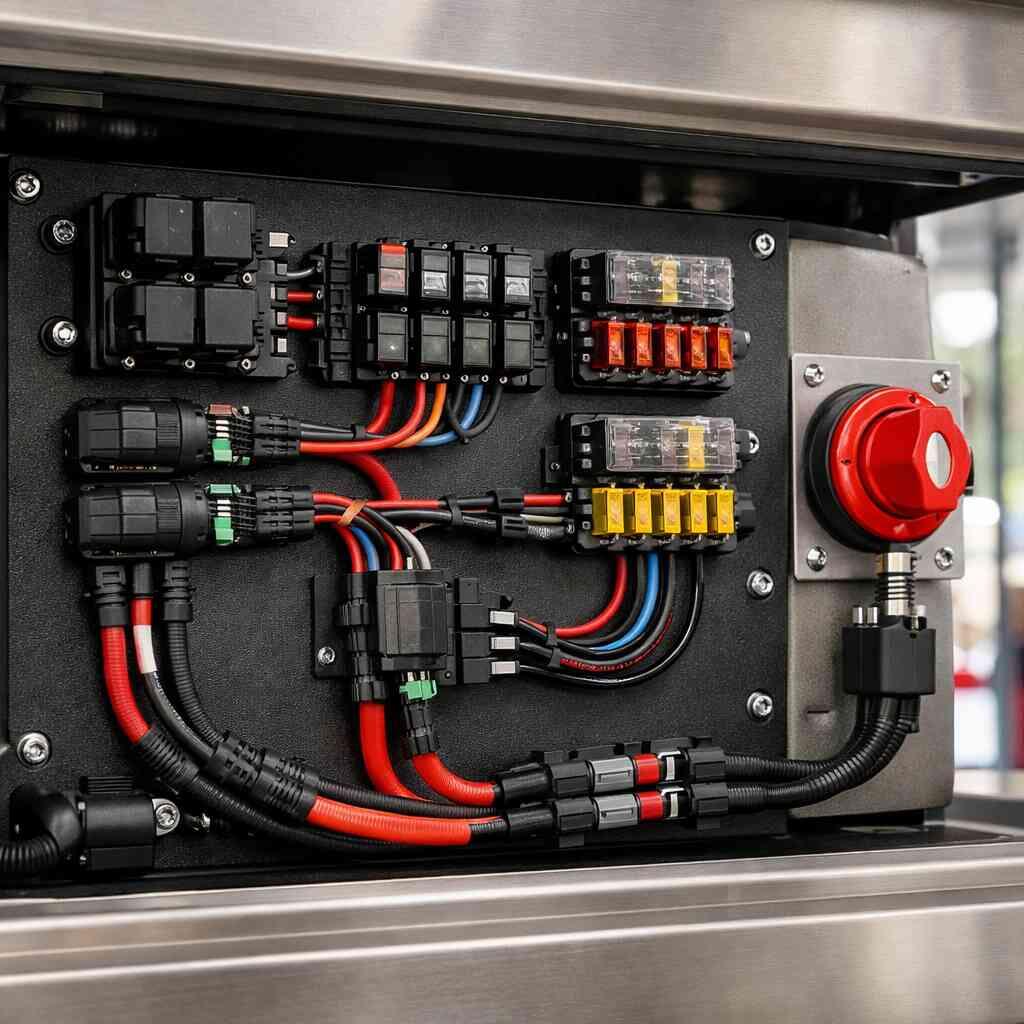
For many apparatus layouts, pigtails solve a practical problem. They give you flexibility, spacing, and cleaner routing in a confined bay. Fire Power IP68 female electrical connector pigtails can help when the field layout needs a protected receiving point. Fire Power IP68 male pigtails can help when the exposed side needs controlled moisture protection on a routed run.
These parts matter because a good layout is not just protected. It is serviceable. If a tech cannot reach it, inspect it, and replace it cleanly, the layout will cause trouble later. That is especially true when the truck uses field-ready fire truck hardware in tight compartments.
Where IP68 male female electrical extensions can reduce exposure in fire apparatus weather sealing
Sometimes the best fix is distance. Moving a connection away from a spray zone can improve the whole system. That is where IP68 male female electrical extensions can reduce exposure. They let you relocate the vulnerable point to a better location.
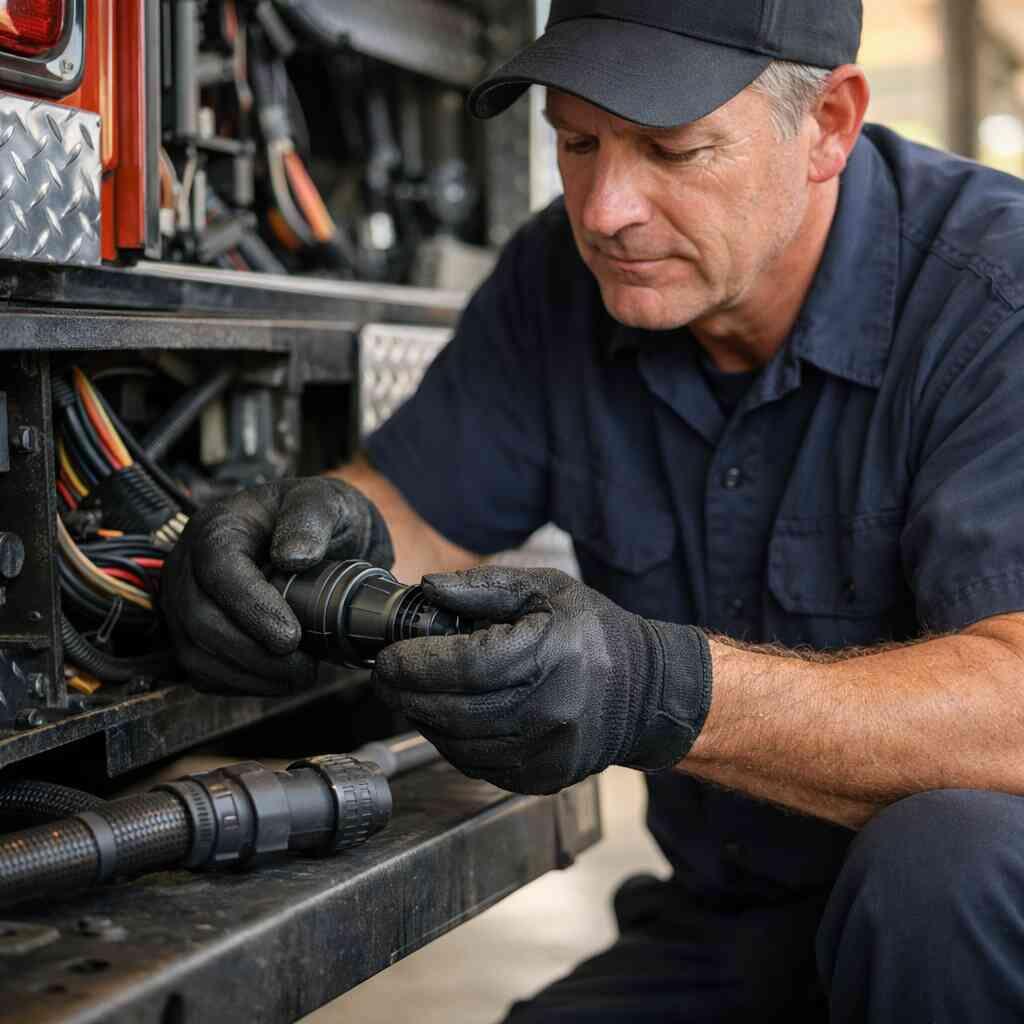
This approach often helps around doors, transitions, and compartment edges. It can also simplify future service. A technician can disconnect one section without disturbing the entire harness. That supports all-weather fire apparatus protection while keeping maintenance manageable.
The important part is routing. An extension only helps if it avoids sharp edges, heat, and pinch points. Otherwise, you simply move the problem.
The next move that turns a good seal choice into a dependable apparatus standard
Choosing a seal is only the beginning. Standardizing it is where the value shows up. The best fleets create a repeatable approach for inspection, replacement, and routing. That is how you move from one repair to fewer repairs.
This is also where emergency vehicle ingress protection becomes a fleet practice instead of a one-off fix. You want something crews can understand quickly. You want something technicians can maintain without improvisation. And you want something that still performs after repeated washdowns and summer heat.
How to compare ingress protection for fire equipment against real maintenance needs and field access
A rating is useful, but maintenance reality matters more. Ask how often the part will be opened. Ask who will service it. Ask whether the design tolerates gloves, grime, and tight spaces. That is the real test for ingress protection for fire equipment.
A simple comparison helps:
FactorBetter choice when you need…Watch out for…Low-profile sealTight spaces and clean routingLimited compression marginBulky enclosureExtra mechanical shieldingPoor access and clutterCable glandStrong entry-point controlIncorrect cable sizingConnector-only protectionFast field replacementWeak cable-entry protectionUse the table as a decision aid, not a substitute for field judgment. The best systems still match the truck’s layout, heat load, and service rhythm.
What to ask before selecting Fire Power Products components for emergency vehicle ingress protection
Before you select components, ask a few direct questions. Where will the part live? How often will it be washed? Who needs access? What route will the harness take? Those questions keep you focused on the real failure modes.
When you look at Fire Power Products, evaluate the component by location and use case first. Then think about sealing method, service access, and replacement path. That is how you protect the investment without creating a maintenance headache. It also fits the realities of heavy-duty connector sealing on working apparatus.
A good purchase is not the most complicated one. It is the one your crew can trust after six months of use. That is the standard worth aiming for.
How to build a maintenance-friendly sealing system that supports all-weather fire apparatus protection
Maintenance-friendly systems are built, not hoped for. Start with the most exposed point. Protect the entry. Protect the transition. Protect the service access. Then verify that replacements are straightforward. That approach supports maintenance-friendly sealing systems in the field.
You can make the system easier to live with by following a few habits:
- Keep the cable path short and direct
- Avoid unnecessary adapters
- Protect sharp edges with proper grommets or glands
- Label the service points clearly
- Inspect seals after washdowns and rough runs
These steps sound simple, but they prevent the slow failures that cost the most time. They also support firefighter safety and apparatus maintenance by reducing surprise outages.
When to contact Duraline in DeLand Florida for fire truck component reliability guidance and application matching
Sometimes you need a second set of eyes before you lock in a layout. That is especially true if the truck has tight space, mixed-age components, or repeated moisture issues. In those cases, contact Duraline in DeLand, Florida for fire truck sealing guidance and application matching. The point is not to oversell a part. It is to match the component to the job.
Fire Power products are built for demanding conditions, and that reputation matters only if the fit is right. So start with the truck, the route, and the exposure level. Then build from there. You do not have to solve every issue today, and you do not have to do it alone. Start with one call, one panel, and one honest inspection of the place water keeps finding.
Frequently Asked Questions
Question: What makes an IP68 seal for fire trucks a better choice than a standard seal on summer calls and washdowns?
Answer: An IP68 seal for fire trucks is designed for stronger ingress resistance, which matters when heat, vibration, road grit, and hose-downs all hit the same component. On working apparatus, the best choice is not just about keeping water out on day one. It is about maintaining a dependable seal through thermal cycling, repeated door movement, and service access. Fire Power Products focuses on durable, field-ready solutions that are intended for demanding fire apparatus environments, but the right part still depends on the exact location and application. For compartments, pump panels, and exterior connections, the goal is a sealing approach that supports fire truck waterproof sealing, dustproof connector protection, and long-term fire truck component reliability.
Question: How do I choose between heavy-duty connector sealing, sealed cable glands for fire trucks, and a low-profile sealing solution for fire trucks?
Answer: The right choice depends on where the weakness is in the system. If the issue is the cable entry point, sealed cable glands for fire trucks can provide better control than connector-only protection. If the area has tight clearance, a low-profile sealing solution for fire trucks may be the better fit because it avoids crowding the compartment and makes service easier. Heavy-duty connector sealing is often the right answer when the exposed plug or receptacle is the main concern. The safest approach is to match the sealing method to the layout, access needs, and exposure level. Fire Power Products can help you think through those tradeoffs so the final setup supports maintenance-friendly sealing systems instead of creating new service problems.
Question: In What Is the Best IP68 Seal for Fire Trucks in Summer 2026, what should crews look for in fire apparatus weather sealing and moisture protection for emergency vehicle electronics?
Answer: Crews should look for a seal that holds up under heat, vibration, washdowns, and repeated use, not just a component that looks good in the shop. Good fire apparatus weather sealing should protect the most vulnerable points first: compartment cutouts, cable exits, door interfaces, and exterior connectors. Moisture protection for emergency vehicle electronics also depends on how the harness is routed, whether the part is easy to inspect, and whether the seal can be serviced without damaging surrounding wiring. A strong solution should support water intrusion prevention for fire trucks while also helping with dust and debris exclusion seal performance. Fire Power Products is built around rugged use conditions, so the practical question is always fit, access, and durability in the actual truck environment.
Question: When does sealed harness protection matter more than connector-only protection on emergency vehicles?
Answer: Sealed harness protection matters most when the cabling runs through hot, wet, gritty, or high-movement zones. A connector alone can only protect the endpoint, while the harness itself can still chafe, flex, or let moisture migrate along the route. That is why reliable seal for fire apparatus cabling is often a system-level decision, not a single-part fix. If the route crosses a sharp edge, hinges near a compartment door, or passes close to a wash path, protecting the whole run becomes more important than upgrading only the connector. Fire Power Products can be a good fit for these situations because the company’s focus is on ruggedized fire truck accessories and parts intended for demanding service, but the layout still has to be planned correctly for the truck.
Question: What should I ask before selecting Fire Power Products components for fire truck component reliability and emergency vehicle ingress protection?
Answer: Before selecting any part, ask where it will live, how often it will be washed, how much vibration it will see, and who needs to service it later. Those questions help determine whether you need ingress protection for fire equipment, a watertight seal for apparatus compartments, corrosion-resistant sealing components, or a more compact routing solution. You should also think about UV resistant sealing materials, thermal cycling resistant seal performance, and whether the installation needs a maintenance-friendly sealing system. Fire Power Products, based in DeLand, Florida, is positioned around durable fire safety equipment for demanding conditions, but the best result comes from matching the part to the application rather than assuming one universal seal solves every problem. If the truck has repeated moisture issues or a complicated compartment layout, it can also make sense to contact Duraline in DeLand, Florida for application matching guidance.