How to Choose 2026 Fire Truck Connectors in DeLand
July 8, 2026
Why the connector that looked fine on paper fails on a fire truck in DeLand
The connector looked perfect on paper. Then the rig hit rough pavement, the bay got washed down, and the lights flickered at the wrong moment. If you are sorting through fire truck connectors and feeling uneasy, that reaction makes sense. The hard part is that the failure often hides until the truck is already back in service. In DeLand, that gap matters more than most people think.
The hidden mismatch between amperage, fitment, and emergency vehicle uptime
A connector can carry the right amperage and still fail the job. Fitment, locking behavior, and contact stability matter just as much. That is the part most people miss when choosing fire truck connectors. A loose latch or poor pin engagement can create heat, intermittent power, or downtime. For emergency vehicle connector compatibility, the real test is the full system, not the label alone.
We hear this from clients who expected a quick replacement. Then the connector body fit, but the routing did not. Or the accessory load changed after an upfit, and the original selection no longer matched. One station-side crew in central Florida had a warning light circuit that kept dropping during acceleration. The connector looked clean, but the pin tension had already weakened from repeated cycling.
The safest approach is to treat connector selection for fire apparatus like a system decision. Check current draw, mounting depth, strain relief, and mating geometry together. If the connector serves fire apparatus electrical connectors in a critical circuit, a near-match is not good enough. You want reliable fire truck electrical components that hold contact under movement and repeated use. That is where connector fitment for emergency vehicles becomes a reliability issue, not a convenience issue.
How Florida heat, humidity, and road vibration change the connector decision
Florida weather changes the math. Heat softens materials faster. Humidity encourages corrosion. Vibration from daily road use turns every loose surface into a lever. Those forces make heavy-duty vehicle connectors look less impressive if they were chosen only for general toughness. In practice, high-vibration connector performance matters every mile.
On the projects we’ve finished this year, the failures that looked random were usually predictable. The connector body had begun to discolor. The seal had flattened. Or the locking tab still clicked, but not with enough force to stay secure through vibration. That is why connector durability in demanding conditions should guide the purchase, especially for Florida fire apparatus connectors. DeLand weather does not forgive weak sealing or brittle jackets.
Here is the part most people overlook. Heat plus humidity does not just damage the shell. It also changes how contamination moves inside a connection. A tiny gap can become a path for moisture. That is why weather-resistant connectors and corrosion-resistant connectors deserve more weight than brand familiarity. A familiar brand name is not proof of emergency service vehicle reliability.
When sealed electrical connectors matter more than brand familiarity
Brand loyalty can help, but it should not lead. If the circuit faces spray, washdown, or road splash, sealed electrical connectors often matter more than a recognizable name. The best choice is the one that supports the environment around the truck, not the one that simply sounds proven. For that reason, hose-down resistant connectors deserve serious attention in apparatus bays and exterior mounting points.
We saw a small rescue unit come in after repeated moisture issues near the rear lighting circuit. The team had replaced the bulbs twice. The real issue was water intrusion through a connector that never belonged in that location. Once the connection was changed to a better sealed option, the repeat fault stopped. That is the kind of problem choosing connectors for emergency lighting should help prevent.
If you want a practical rule, use this one: the harsher the exposure, the less you should rely on open or lightly protected connectors. Match the connector to the environment first. Then verify amperage and fitment. If you need a deeper reference point, choosing fire truck connectors in DeLand should always start with the environment the rig actually lives in.
The decision map that separates fire apparatus electrical connectors from generic heavy duty parts
Generic parts often promise durability. Fire apparatus needs more than that. The truck carries accessory loads, lights, pumps, controls, and wiring paths that must stay predictable under stress. So the decision is not simply about ruggedness. It is about connector compatibility with apparatus upfits and the exact job the circuit performs.
Matching connector type to fire apparatus wiring connectors and accessory loads
Start with load type. A low-draw control circuit has different needs than a high-amp accessory line. The safest path is to match the connector to the wire gauge, current demand, and duty cycle. That is the core of fire apparatus electrical connector selection. If you skip this step, you can end up with heat buildup, poor retention, or premature wear.
A useful way to think about it is simple: the connector must match the load, the environment, and the service access. That is why fire truck wiring connectors and accessory loads should be reviewed together. On a fire apparatus, a connector that works for a static bench setup may struggle once the rig starts bouncing and the hose bed gets washed. Industrial-grade vehicle connectors are only useful if they fit the actual duty.
For some buyers, heavy-duty vehicle connectors for fire apparatus sounds like the answer to everything. It is not. Heavy-duty is a category, not a guarantee. Your decision should separate the circuit’s purpose from the connector’s marketing language. That keeps first responder equipment connectivity grounded in reality.
Choosing between male pigtails, female pigtails, and extension assemblies
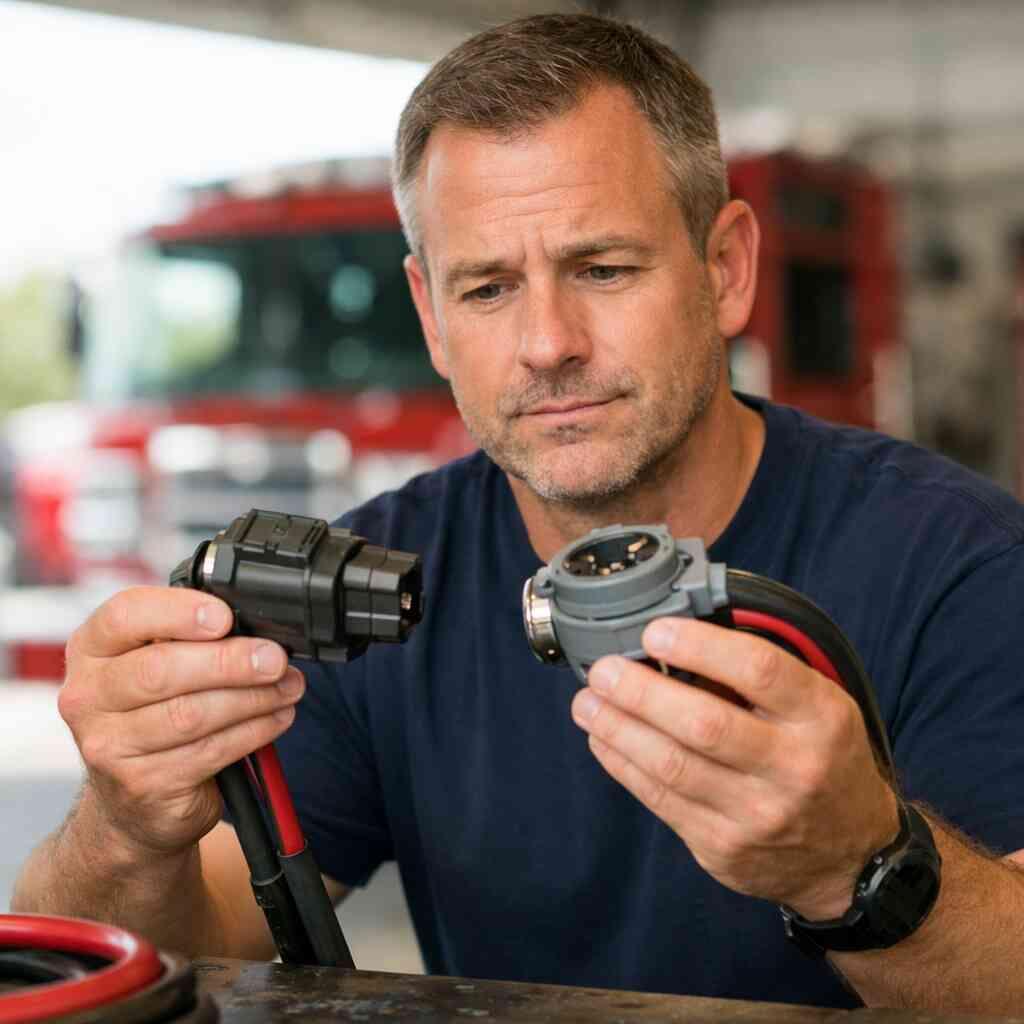
This is where many people slow down, and rightly so. The wrong assembly can make a clean install harder to service later. Male pigtail connectors for fire fighting equipment often make sense where you need a defined output side. Female pigtail connector options for fire apparatus are useful where protection and mating control matter. Extension assemblies for fire truck power connections help when routing distance or panel layout requires a longer run.
Here is a simple comparison to keep the choice clear.
OptionBest useMain advantageMain cautionMale pigtailsOutput-side terminationsClear mating pathExposed pins need careful handlingFemale pigtailsProtected connection pointsBetter exposure controlMust match the correct mateExtension assembliesDistance and routing needsCleaner cable managementExtra connection points require inspectionThe mistake we see most often is choosing the part that is easiest to find, not the one that fits the layout. That gets expensive later. If you are evaluating fire truck wiring connectors and accessory loads, think in terms of service access too. A connector that is easy to reach for inspection usually performs better over time. That is a small detail with big consequences.
Where IP68 style sealing belongs in a real-world apparatus electrical system
Sealing should follow exposure. Not every connection needs the highest level of protection, but many exterior or washdown-prone locations do. IP68-style sealing belongs where water, dust, and repeated hose-downs can reach the connection. That is especially true for exterior-mounted accessory circuits and lower-body routing zones. In those areas, sealed electrical connectors for emergency vehicle wiring can reduce nuisance failures.
The key is to avoid overusing sealing language as a marketing shortcut. A sealed connector is not automatically the right connector. It still needs the right contact design, strain relief, and installation quality. If you want to compare actual sealing approaches, corrosion-resistant and weather-resistant connectors for fire trucks are a useful concept to study, especially for rigs that see frequent washdown. You want rugged connector assemblies that balance protection with serviceability.
What to inspect before you buy replacement connectors for fire apparatus
Buying replacements too quickly causes repeat failures. Slow down long enough to inspect the old connector, the wiring path, and the surrounding equipment. That is the most practical way to improve apparatus electrical system reliability. A good inspection tells you whether the issue was the connector itself, the mating surface, or the installation. It also helps you avoid replacing the wrong part.
Reading the connector body for corrosion resistance, weather resistance, and lock integrity
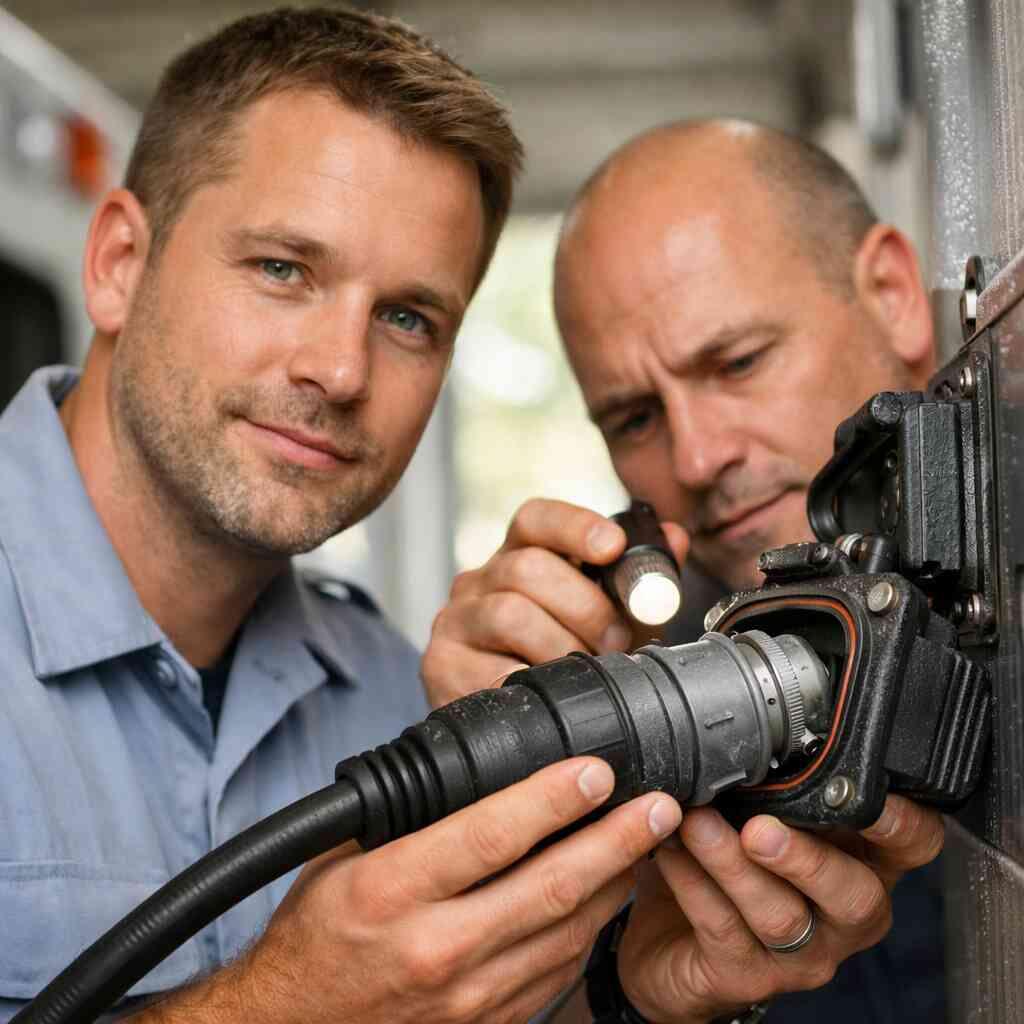
Look at the shell first. You are checking for cracks, heat marks, pitting, and softened plastic or polymer surfaces. Then inspect the latch or lock area. If the lock feels vague, the connection may already be compromised. For corrosion-resistant connectors, the outer body should show no obvious signs of chemical wear or salt intrusion.
Weather tells its own story on a truck. A clean-looking connector can still hide internal oxidation. That is why weather-resistant connectors should be judged by more than appearance. Ask yourself whether the lock still snaps with authority, whether the strain relief is intact, and whether the mating surfaces stay aligned. If the connector has seen repeated washdowns, treat that history seriously. Connector inspection checklist habits save time and prevent failures later.
Verifying compatibility with upfits, lighting equipment, and fire truck power connections
Upfits change everything. A truck that left the factory with one lighting setup may now carry another. That means connector compatibility for apparatus upfits and emergency vehicles needs to be rechecked before ordering parts. A perfect replacement on paper can still fail the install if the accessory housing, connector keying, or wire lead length does not match. This is especially important when deciding how to choose connectors for emergency lighting on fire trucks.
Before you buy, verify these points:
- Current draw of the attached load
- Wire gauge and routing path
- Mating profile and keying
- Available clearance behind the panel
- Exposure to spray, heat, or abrasion
That list sounds basic, but it catches most surprises. A short pause now can prevent a long service issue later. If you need a deeper compatibility check, fire apparatus electrical connector selection should always include the upfit, not just the part number.
Using a connector inspection checklist to catch heat damage, abrasion, and water intrusion
Heat damage often appears before total failure. You may see darkening near the contact area. Or the insulation may feel brittle. Abrasion can be even more deceptive, because it starts as a thin rub mark and ends as a broken jacket. Water intrusion usually shows up as corrosion, green residue, or intermittent operation after washing. Connector troubleshooting for fire trucks is easier when you know what to look for.
Use this practical inspection sequence:
- Check the shell for cracks or discoloration.
- Test the lock and release motion.
- Inspect pin alignment and contact tension.
- Look for abrasion at bend points.
- Check for moisture, residue, or rust.
One crew we spoke with had a recurring failure near a compartment door. The issue was not the lamp, and it was not the fuse. It was abrasion where the harness rubbed against a metal edge every time the door opened. Once the connector area was rerouted and protected, the fault disappeared. That is why replacement connectors for fire apparatus should never be chosen without looking at the route they live in.
The next move that protects reliability on the rig and in the bay
The best connector is only as good as the maintenance behind it. Good habits extend life. Poor habits shorten it fast. If you want fire truck connector maintenance to work, make it part of the bay routine, not an afterthought. The truck will tell you when a connection is weakening, but only if you are looking.
Building a maintenance routine for connector durability in demanding conditions
A useful routine is simple and repeatable. Inspect the most exposed connectors during each service cycle. Clean only with methods approved for the material and application. Confirm that the lock still seats firmly. Then verify that the routing has not shifted or rubbed. This supports fire truck connector maintenance in demanding conditions without turning every check into a full teardown.
The most reliable shops build connector checks into other work. If a hose bed gets washed, inspect the nearby connectors. If an upfit gets repaired, inspect the mating points too. If a unit comes back from road use with unexplained flicker, inspect before replacing the whole assembly. That is the practical side of durable connector solutions. It keeps small issues from becoming road calls.
When to replace versus repair suspicious firefighter equipment connectors
Not every suspicious connector needs immediate replacement. Some need cleaning, reseating, or a corrected route. But there is a line. If you see heat damage, repeated moisture intrusion, loose retention, or a cracked housing, replacement is usually the better choice. Firefighter equipment connectors that have already failed once deserve careful scrutiny before you trust them again. Reliable fire truck electrical components should not require constant coaxing.
A quick decision rule helps:
- Repair if the issue is external, minor, and reversible.
- Replace if the body, lock, or contacts show damage.
- Replace if the fault returns after a proper correction.
- Replace if the connector sits in a harsh exposure zone.
That rule keeps the decision honest. It also protects uptime. A cheap repair that fails next week costs more than a proper replacement today. If you are unsure, sealed electrical connectors for emergency vehicle wiring are often worth the conservative choice in exposed locations.
How to narrow the final selection for dependable connectors for public safety vehicles in DeLand
At this point, narrow the field by environment, load, and service access. Then choose the connector that matches all three. For dependable connectors for public safety vehicles in DeLand, that usually means good sealing, solid retention, and clear compatibility with the truck’s accessory system. DeLand heat and humidity make sloppy choices more expensive. Local service life is shaped by weather, road vibration, and washing patterns more than most spec sheets admit.
If you want a final filter, use these questions:
- Will this connector stay secure under vibration?
- Can it handle the exposure around this mounting point?
- Does it match the current load and wire path?
- Will the bay crew be able to inspect it quickly?
That simple filter prevents a lot of regret. It also keeps the purchase practical. If you need a local next step, contact a local fire equipment supplier near DeLand and compare your truck’s real-world needs against the connector options on hand. You do not have to solve every detail alone, and you do not have to solve them all today. Start with one careful inspection and one good conversation.
Frequently Asked Questions
Question: In How to Choose 2026 Fire Truck Connectors in DeLand, what should I look for first when comparing fire truck connectors for a fire apparatus?
Answer: Start with the basics that affect reliability on the rig: current load, fitment, sealing, and strain relief. A connector can look right on paper and still fail in the field if the mating geometry, lock retention, or routing does not match the actual truck setup. For fire apparatus electrical connectors, the safest approach is to evaluate the full system, not just the part number. That includes connector compatibility with apparatus upfits, wire gauge, exposure to heat and humidity, and whether the connection will stay secure under vibration. In DeLand, Florida, those details matter because heat, moisture, and washdown conditions can shorten the life of weaker connections. Fire Power Products focuses on durable connector solutions that are built for demanding fire and rescue environments, so you can narrow your choice with more confidence and less guesswork.
Question: How do I choose between sealed electrical connectors, weather-resistant connectors, and hose-down resistant connectors for fire truck wiring connectors?
Answer: The right choice depends on exposure. If the connector is near spray, washdown, road splash, or compartment moisture, sealed electrical connectors are usually the smarter starting point. For lower-risk interior locations, weather-resistant connectors may be enough if the circuit is protected and easy to inspect. Hose-down resistant connectors are especially relevant around apparatus bays and exterior mounting points where repeated cleaning is part of normal use. The key is not to overbuy or underbuy protection. A connector should match the environment first, then the load and service access. Fire Power Products offers reliable fire truck electrical components designed for demanding conditions, which helps buyers avoid the common mistake of choosing based on brand familiarity alone. In practical terms, better sealing supports apparatus electrical system reliability and reduces nuisance failures that can pull a truck out of service.
Question: What makes connector selection for fire apparatus different from buying generic heavy-duty vehicle connectors?
Answer: Fire apparatus has a much more demanding electrical life than many generic heavy-duty vehicles. The truck may carry lighting, controls, pumps, accessories, and other first responder equipment connectivity needs that must stay dependable under constant motion and repeated service. That means connector selection for fire apparatus has to account for high-vibration connector performance, corrosion resistance, service access, and compatibility with the upfit. Generic industrial-grade vehicle connectors may be rugged, but rugged alone does not guarantee the right fit or long-term stability in emergency use. Fire Power Products understands that fire truck power connections need to be practical in the bay and reliable on the road. By focusing on the actual duty cycle and environment, you get better connector fitment for emergency vehicles and fewer surprises after installation.
Question: What should I inspect before ordering replacement connectors for fire apparatus or firefighter equipment connectors?
Answer: Before replacing anything, inspect the old connector body, the latch or lock, the contact area, and the surrounding harness route. A good connector inspection checklist should look for cracks, heat damage, corrosion, abrasion, moisture intrusion, and weak retention. If the connector shows discoloration, brittle insulation, looseness, or repeated intermittent faults, it may be time to replace it rather than repair it again. This step is especially important for connector troubleshooting for fire trucks because the true problem is often the mounting location or harness route, not the lamp or device itself. Fire Power Products helps customers think through replacement connectors for fire apparatus in a practical way, so the new part matches the environment, the load, and the available clearance. That careful approach supports connector maintenance for fire trucks and helps protect uptime.
Question: Can Fire Power Products help me choose connectors for emergency lighting and other fire truck wiring connectors with upfits?
Answer: Yes, and that is one of the most important places to slow down and verify compatibility. Choosing connectors for emergency lighting is not just about matching amperage. You also need to confirm keying, mating profile, wire length, mounting depth, and how the connector will be serviced later. Upfits often change the original layout, so connector compatibility with apparatus upfits should be checked before ordering replacement parts. Male pigtails, female pigtails, and extension assemblies each solve different routing and access problems, so the right answer depends on how the truck is built and where the load sits. Fire Power Products is built around durability for fire and rescue equipment, so the goal is to support dependable connectors for public safety vehicles without overcomplicating the install. If you are working with DeLand fire truck equipment or DeLand emergency vehicle parts, a careful compatibility review is the best way to avoid repeat failures.
Question: Why should I trust Fire Power Products for Florida fire apparatus connectors in DeLand?
Answer: Fire Power Products is a strong fit for buyers who want practical, dependable connector options for demanding service conditions in DeLand, Florida. The brand focus is on durable connector solutions, USA-made fire safety components, and products intended for high usage and harsh environments. While every application still needs proper verification of specifications and compatibility, that durability-first mindset is exactly what matters when choosing fire truck connectors for an apparatus that sees vibration, humidity, and washdown. For local buyers, working with a local fire equipment supplier can make the selection process easier because you can compare the truck’s real-world needs against the available parts. If you want reliable fire truck electrical components that support apparatus electrical system reliability, Fire Power Products gives you a practical place to start. The best results still come from matching the connector to the environment, but having a trusted source helps make that decision much easier.